1/2" v 3/4" Garden Hose - Why It Matters
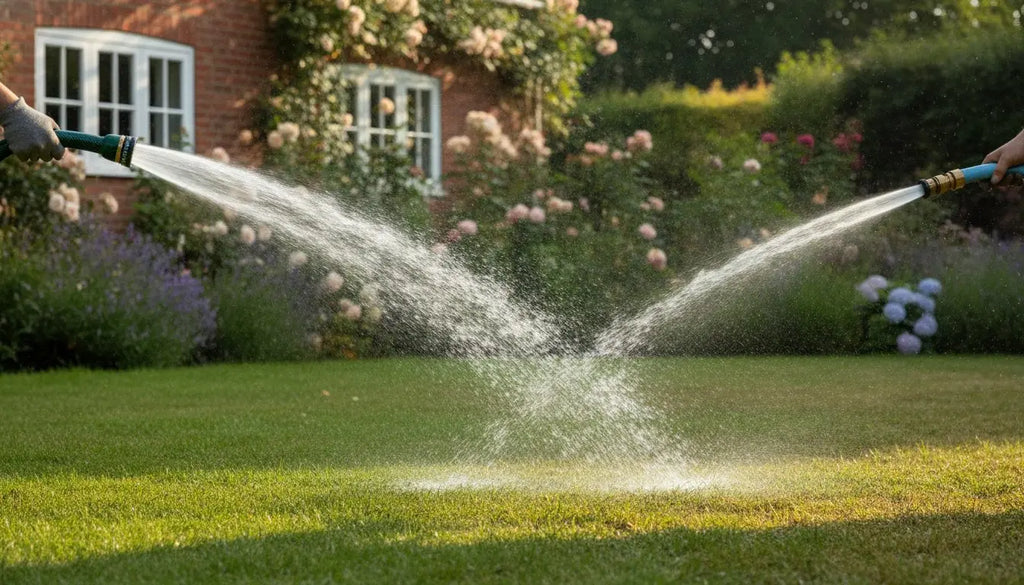
A 3/4-inch hose delivers approximately three times as much water as a 1/2-inch hose in the same amount of time. This simple measurement can be the difference between a thriving lawn and a struggling garden. Most gardeners know the frustration of low water pressure at the end of a long run or the physical strain of coiling a hose that's far too heavy for the task. If you're weighing up a 1/2" v 3/4" Garden Hose, it's likely because you've dealt with leaking connectors or a sprinkler that just won't reach the corners of your flower beds.
You'll discover the critical differences between these diameters so you can choose the perfect hose for your specific water pressure and irrigation needs. This guide breaks down how hose width affects flow volume, weight, and compatibility with Hozelock systems. We'll ensure you find the right balance to keep your automatic watering systems performing at their best while keeping the hose easy to manage and move around. Our goal is to help you build a reliable setup that makes garden maintenance a simple and efficient part of your routine.
Key Takeaways
- Learn how internal diameter impacts your watering efficiency and why the 1/2-inch hose remains the standard choice for most UK gardens.
- Understand why a 3/4-inch hose provides significantly higher flow volume, making it the ideal partner for Hozelock pop-up lawn sprinklers.
- Resolve the 1/2" v 3/4" Garden Hose dilemma by matching the right diameter to your specific garden length and water pressure needs.
- Find out how to use Hozelock connectors to build a leak-free system that bridges different hose sizes and tap threads with ease.
- Discover the benefits of a hybrid setup, using multiple hose diameters to ensure consistent performance across your entire irrigation network.
Understanding Garden Hose Sizes: What Do 1/2" and 3/4" Actually Mean?
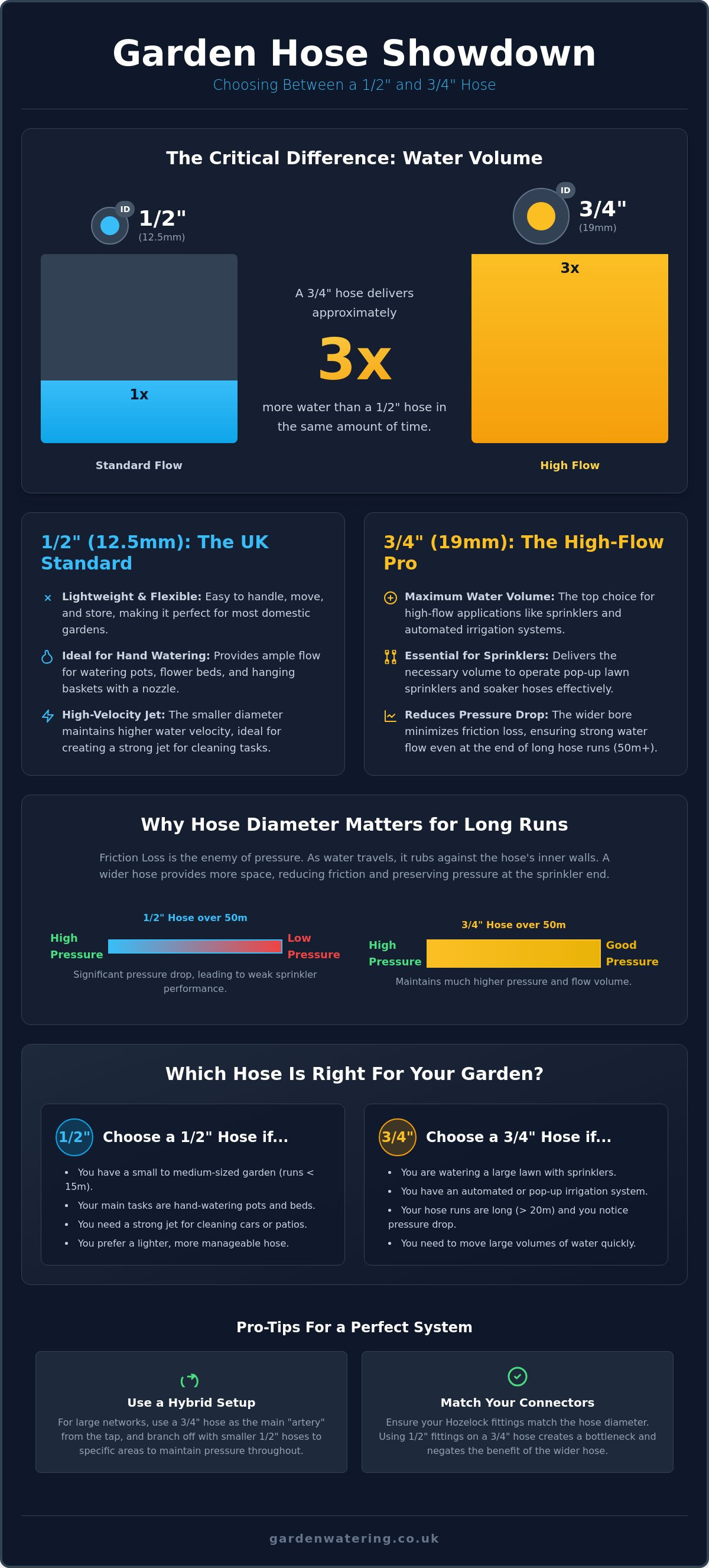
Choosing the right equipment starts with understanding the numbers. When you compare a 1/2" v 3/4" Garden Hose, the measurement you see on the packaging refers specifically to the internal diameter (ID) of the pipe, often called the 'bore'. In the UK, the 1/2-inch hose (typically measuring between 12.5mm and 13mm) is the standard for domestic gardens. It's lightweight, easy to store, and provides enough flow for most hand-watering tasks.
A 3/4-inch hose, which measures approximately 19mm internally, is a heavy-duty alternative designed for high-flow requirements. While the internal space increases, the exterior size can vary significantly depending on the wall thickness and material. For instance, a multi-layered braided hose will have a much thicker wall than a basic PVC version to prevent kinking under pressure. These standards are often tied to the Garden Hose Thread (GHT) used for connectors, ensuring that your fittings match the volume your hose can handle without creating a bottleneck at the tap.
To better understand how these sizes impact performance in a real-world setting, watch this helpful flow test comparison:
Measuring the Internal Diameter
To get an accurate reading of your hose size, you should always measure the bore rather than the outer casing. High-quality hoses often have thicker walls to prevent kinking, which can make a 1/2-inch hose look much larger from the outside. In UK shops, you'll frequently see metric equivalents like 12.5mm for the standard size and 19mm for the larger bore. If you're unsure what you currently have, try fitting a standard Hozelock connector. A standard quick-connect fitting is designed for 12.5mm to 15mm hoses. If your hose is too wide to fit into the nut of a standard connector, you likely have a 19mm 'High Flow' version.
The Role of Hose Length
Length acts as a multiplier for the performance differences between these two sizes. On a standard 15m run, a 1/2-inch hose performs admirably for most garden sprinklers. However, if you're running a 50m professional irrigation line, the friction caused by the water rubbing against the inner walls will significantly drop your pressure. Understanding the 1/2" v 3/4" Garden Hose distinction is vital for anyone setting up a permanent irrigation system over a large area. Using a 3/4-inch hose for these longer runs reduces this friction and ensures your water reaches the end with more force. Bore size is the primary factor in determining the total volume of water delivered to your plants. Choosing the right diameter for your run length prevents the common issue of 'pressure drop' that leaves sprinklers sputtering.
Flow Rate and Pressure: The Science of Hose Diameter
Many gardeners confuse water pressure with flow volume. While your tap provides a set amount of static pressure measured in Bar, the amount of water actually exiting the nozzle is the flow volume, measured in Litres Per Hour (LPH). When comparing a 1/2" v 3/4" Garden Hose, the larger diameter isn't about increasing the pressure from the tap. Instead, it's about maintaining the volume of water over the distance of the pipe. A 3/4" hose has roughly double the cross-sectional area of a 1/2" hose. This extra space allows for a much higher volume of water to pass through without being slowed down by the pipe's internal surface.
According to experts at Flexon Industries, Choosing the Right Hose Diameter is essential because a wider hose reduces the 'choke point' created by narrow fittings. While the 3/4" hose excels at moving large volumes of water, the standard 1/2" hose is often better for maintaining high-pressure jets used in cleaning. Because the water is forced through a smaller space, it maintains a higher velocity, which is perfect for rinsing down a patio or car where you don't need hundreds of litres of water per minute.
Friction Loss Explained
Friction loss is the primary reason your sprinkler might struggle at the end of a long lawn. As water travels, it rubs against the inner walls of the hose pipe, which saps energy and reduces flow. In a narrow 12.5mm line, a higher percentage of the water is in contact with the sides, creating significant resistance. If you double the length of your hose, you don't just double the resistance; you can compound the pressure drop to the point where your equipment fails to operate. This is why we often recommend a larger bore for any run exceeding 25 metres.
Flow Rate Comparison: 1/2" vs 3/4"
To see the difference in action, consider how these sizes perform under a standard UK mains pressure of 3 Bar. A 3/4-inch hose delivers approximately three times as much water as a 1/2-inch hose in the same amount of time. This efficiency is why we recommend specific diameters for pop-up lawn sprinkler systems to ensure they reach their maximum spray radius.
| Hose Diameter | Typical Flow Rate (LPH) | Time to Fill 10L Bucket |
|---|---|---|
| 1/2" (12.5mm) | Approx. 1,000 LPH | 36 Seconds |
| 3/4" (19mm) | Approx. 3,000 LPH | 12 Seconds |
Upgrading your main supply line is often the most effective solution if you find your current irrigation kits aren't receiving enough volume to function correctly.
Choosing Based on Your Watering Needs: Practical Scenarios
The decision between a 1/2" v 3/4" Garden Hose depends entirely on the layout of your outdoor space and the specific tasks you perform. While the science of flow volume is clear, the practical reality of dragging a hose across a lawn or around tight corners often dictates the best choice. You need to balance the necessity of water delivery with the physical effort required to manage the equipment. Small urban plots present a different set of challenges compared to sprawling rural landscapes, and your choice of diameter should reflect that difference.
When a 1/2" Hose is More Than Enough
For the majority of UK homeowners, a 12.5mm (1/2-inch) hose is the most sensible choice. These hoses are lightweight and exceptionally easy to coil, making them ideal for gardeners who need to navigate around garden furniture, pots, or narrow side paths. If your primary tasks include hand-watering patio containers with Hozelock spray guns or washing the car, the standard diameter provides more than enough velocity.
Standard 1/2-inch hoses are also the primary design focus for most Hozelock watering kits. Their reduced weight is a significant benefit for elderly gardeners or those with limited mobility, as a full 30-metre reel of 19mm hose can be surprisingly heavy to pull. If your garden is under 15 metres in length, you'll rarely notice the flow limitations of the smaller bore.
Why High-Demand Systems Require 3/4" Hoses
When you move into the territory of automatic irrigation, the requirements change. Professional landscapers almost exclusively use 19mm (3/4-inch) supply lines because they provide the necessary volume to feed multiple outlets simultaneously. If you are installing pop-up lawn sprinkler systems, a 3/4-inch hose is often essential to ensure the heads have enough water to pop up and reach their full spray radius.
Large-scale drip irrigation systems also benefit from the larger diameter. By using a 3/4-inch 'header' pipe, you ensure that the dripper at the very end of the line receives the same amount of water as the one closest to the tap. This prevents the common issue of pressure drop where plants at the far end of a garden begin to wilt. In these high-demand scenarios, the 1/2" v 3/4" Garden Hose debate is settled by the needs of the hardware rather than the preference of the gardener. Efficiency in these systems relies on a steady, high-volume supply that only a larger bore can provide reliably over long distances.
Fittings, Taps, and Connectors: Ensuring a Leak-Free System
A common source of frustration for many gardeners is a leaking connection at the tap. This usually happens because there's a misunderstanding of how the hose pipe diameter relates to the tap thread size. When you're choosing between a 1/2" v 3/4" Garden Hose, it's vital to remember that the hose size doesn't necessarily dictate your tap size. You can run a 1/2-inch hose from a 3/4-inch tap, provided you use the correct transition fittings. Ensuring a secure, leak-free system requires matching your components with precision, particularly when dealing with the higher flow volumes of larger bore pipes.
Decoding UK Tap Sizes (BSP)
Most outside taps in the UK use British Standard Pipe (BSP) threads. The two most common sizes are 1/2" and 3/4" BSP, but these names can be deceptive. A 3/4" BSP tap thread actually measures approximately 26mm in diameter when you use a ruler across the threads. Similarly, a 1/2" BSP thread measures around 21mm. Choosing the right tap connector is the first step in building a reliable system. If you have a larger 3/4" BSP tap, you'll need a specific adaptor to connect your hose reel. We always recommend checking your tap size before purchasing your main supply line to avoid unnecessary trips back to the shop.
Using Hozelock Connectors for Different Hose Sizes
Standard Hozelock connectors are typically designed for 12.5mm (1/2") or 15mm hoses. If you've opted for a 3/4" hose for its high-flow benefits, you must use specific 19mm connectors. Forcing a larger hose into a standard fitting is a recipe for leaks and 'blow-offs', where the pressure causes the hose to pop out of the connector. For high-pressure runs or permanent installations, 'Pro' metal connectors offer a more robust grip on the thicker walls of a 19mm pipe.
When designing Hozelock automatic watering systems, many users choose to step down from a 3/4" main supply to a 1/2" hose for the final reach. This approach keeps the volume high for the main run while allowing for the flexibility of a smaller hose near the plants. To achieve this safely, you'll need high-quality irrigation fitting adaptors that can handle the transition without restricting flow. Ensuring every joint is secure prevents water waste and maintains the proficiency of your entire network.
If you're ready to upgrade your setup with professional-grade components, explore our full range of Hozelock connectors to find the perfect fit for your garden.
The Verdict: Which Hose Should You Buy for Your Garden?
The decision between a 1/2" v 3/4" Garden Hose ultimately depends on whether you value convenience or raw performance. For the vast majority of UK homeowners with standard-sized gardens, the 1/2-inch hose remains the champion of everyday use. It provides a perfect balance of flow for hand-watering and car washing while remaining easy to handle. However, if your goals involve professional-grade irrigation or covering vast distances, the 3/4-inch hose is the only way to ensure your equipment receives the volume it needs to function correctly.
You don't necessarily have to choose one over the other. Many efficient systems use a 'hybrid' approach. By running a 3/4-inch hose as a high-volume main supply line to a central point in your garden, you can then branch off with 1/2-inch hoses for the final reach. This method gives you the best of both worlds: the high flow volume required for sprinklers and the lightweight flexibility needed for moving around flower beds. It's a strategic way to build a system that is both powerful and manageable.
Weight and Storage Considerations
Weight is the most frequently overlooked factor when comparing a 1/2" v 3/4" Garden Hose. A 30-metre length of 1/2-inch hose is relatively easy for most people to coil and carry. In contrast, a 30-metre length of 3/4-inch hose full of water is significantly heavier and much more rigid. This rigidity makes the larger hose naturally more resistant to kinking, but it also means it requires a much larger coiling radius.
Storage is another critical point. Most standard hose reels and wall-mounted carts are designed specifically for 12.5mm (1/2") pipes. If you opt for a 19mm (3/4") hose, you must confirm that your reel or cart is explicitly rated for the larger diameter. Attempting to force a 19mm hose onto a standard reel will often result in a tangled mess and can even damage the reel's internal structure over time.
Expert Recommendation for 2026
With 15 years of experience as a specialist in UK irrigation, our expert verdict is straightforward. We recommend 1/2-inch hoses for general gardening, patio maintenance, and small urban plots. For those installing pop-up sprinklers or extensive automatic networks, 3/4-inch is the professional standard for the main supply. We always suggest using high-quality Hozelock watering components to ensure a guaranteed fit and long-term reliability.
Looking forward to 2026, a well-kept garden serves as the perfect backdrop for professional events. For those coordinating such functions in the Sydney area, Casa Catering Sydney offers specialized corporate catering that ensures your hospitality is as impressive as your irrigation setup.
Before you make your final choice, use this checklist to ensure you have the right setup:
- Measure your garden's longest run to check for potential pressure drop.
- Identify if your sprinklers require high flow volume to reach their full spray radius.
- Confirm your outside tap thread size matches your chosen connectors.
- Ensure your storage reel is compatible with the hose diameter.
If you're still designing your layout, you can find more detailed advice in our garden watering system uk guide. We are dedicated partners in your gardening success, providing the expertise you need to keep your landscape healthy and thriving.
Optimise Your Garden Irrigation Today
Choosing between a 1/2" v 3/4" Garden Hose is a decision that directly impacts your garden's health and your own physical comfort. Much like how the right tools protect your well-being, specialized health services such as Nova Premier Dental provide the professional expertise needed to maintain your long-term health and a confident smile. You now understand that while the 1/2-inch hose is the standard for agility, the 3/4-inch alternative is the powerhouse required for complex irrigation networks. Matching your hose diameter to your specific task ensures that your sprinklers reach every corner and your plants receive the exact volume they need. Getting the right connectors and tap adaptors is the final step in creating a system that performs without leaks or pressure drops.
As an official Hozelock stockist with over 15 years of specialist advice, we're here to help you build a setup you can trust. We offer free UK delivery on qualifying orders to make your garden upgrade as smooth as possible. Browse our full range of Hozelock Watering Systems & Hoses to find the perfect fit for your landscape. We're dedicated to your success and look forward to helping you create a thriving, beautiful outdoor space.
Frequently Asked Questions
Will a 3/4-inch hose fit my standard 1/2-inch outside tap?
Yes, a 3/4-inch hose will fit, but you need the correct tap connector. Most UK outdoor taps have either a 1/2" or 3/4" BSP thread. You must use a tap adaptor that matches your specific thread size and provides a 19mm connection point for your hose. Using a high-flow tap connector ensures you don't create a bottleneck right at the water source.
Is 3/4-inch hose better for low water pressure areas?
A 3/4-inch hose is often better for low pressure over long distances because it reduces friction loss. While it won't increase the static pressure coming from your tap, it ensures the volume is not restricted as the water travels. If you have low mains pressure, using a wider bore helps maintain a steady flow for your sprinklers and irrigation kits.
Can I connect a 1/2-inch hose to a 3/4-inch hose?
You can connect these sizes using a specialised reducer or a hose-to-hose connector. This is a practical way to combine the high volume of a 3/4-inch main line with the lightweight manoeuvrability of a 1/2-inch hose for hand-watering. It allows you to maintain performance where it is needed most while keeping the end of the line easy to manage.
Do I need special Hozelock connectors for a 19mm (3/4") hose?
Yes, you must use specific 19mm Hozelock connectors for a 3/4-inch hose. Standard connectors are designed for 12.5mm to 15mm pipes and simply won't fit over the wider 19mm casing. Using the correct high-flow or Pro metal fittings is essential to prevent leaks and ensure the connection doesn't pop off when the system is under pressure.
Why is my 1/2-inch hose pulsing when I use a sprinkler?
Pulsing usually happens when your sprinkler demands more water volume than your 12.5mm hose can provide. This creates a vacuum effect or causes the internal pressure to fluctuate. When comparing a 1/2" v 3/4" Garden Hose, the larger bore provides the consistent volume required to keep high-demand sprinklers running smoothly without these interruptions.
Is a 5/8-inch hose a good compromise between 1/2 and 3/4?
While a 5/8-inch (15mm) hose is a common standard in some markets, it's less frequent in the UK. It can be a decent compromise, but finding compatible fittings in local shops is often more difficult. For most UK gardens, it's more practical to choose 12.5mm for general use or 19mm for high-performance irrigation to ensure full compatibility with standard accessories.
How much heavier is a 3/4-inch hose compared to a 1/2-inch one?
A 3/4-inch hose is approximately twice as heavy as a 1/2-inch hose when full of water. This is because the internal volume is significantly larger, holding more weight per metre. If you have a large garden, the physical effort required to drag or reel in a 30m 19mm hose is much higher, which is why we often recommend them for stationary installations.
Which size hose is best for a Hozelock automatic watering system?
A 3/4-inch (19mm) hose is the best choice for the main supply of a Hozelock automatic watering system. This ensures that your water timer and distributors receive the maximum possible volume. When you're deciding on a 1/2" v 3/4" Garden Hose for automation, the 19mm option prevents pressure drops that could stop your drippers or pop-up sprinklers from functioning at the end of the line.
`-
Posted in
1/2" v 3/4" Garden Hose, Garden Hose, Garden Irrigation, Gardening Tips, Hose Diameter, Hozelock, Sprinkler Systems, Water Pressure, Watering