The Essential Guide to Garden Hose Pipes: Everything You Need to Know for 2026
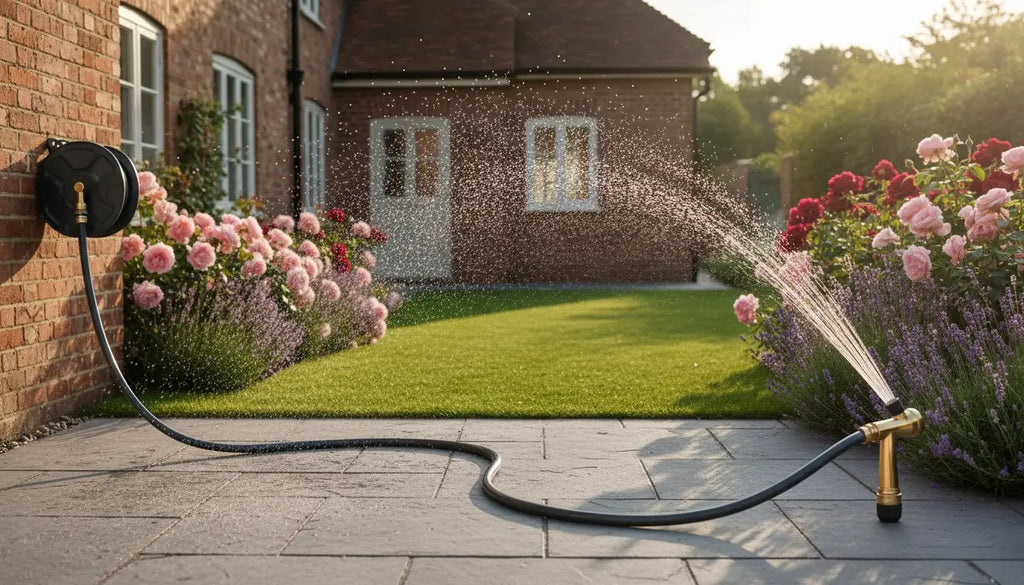
On a warm Sunday afternoon in June 2024, you were likely one of the many British gardeners who found themselves wrestling with a stubborn tangle rather than enjoying the sunshine. We've all been there, standing mid-lawn while the water flow abruptly stops because your hose pipe has kinked for the third time in ten minutes. It's a common frustration that turns a peaceful task into a battle against plastic and pressure, often resulting in soaked shoes and a wasted afternoon. High-pressure bursts and leaking connectors only add to the stress when you simply want to nurture your plants.
We agree that keeping your borders lush and your lawn healthy shouldn't involve pipes that become brittle or discoloured after just one summer. You deserve a watering system that's as dependable as it is efficient. In this guide, we share the specialist science behind durable, anti-kink technology and help you choose the ideal foundation for your British garden. We'll explain why specific diameters and pressure ratings matter for your home's water supply. You'll discover how to achieve a tidy, organised garden with a reliable solution that lasts well into 2026 and beyond.
Key Takeaways
- Understand the anatomy of a high-quality conduit and why the inner core is vital for maintaining both water purity and consistent pressure.
- Compare traditional PVC against modern hybrid polymers to find a durable solution that resists "coil memory" and eliminates kinking.
- Determine whether a standard 12.5mm or a high-flow 19mm hose pipe is the right foundation for your garden’s specific watering requirements.
- Learn how to guarantee universal compatibility between your hose, storage reels, and standard UK outside tap connectors.
- Master expert maintenance techniques to prevent frost damage and permanent deformation, ensuring your irrigation system helps your garden thrive for years.
Understanding the Anatomy of a Quality Garden Hose Pipe
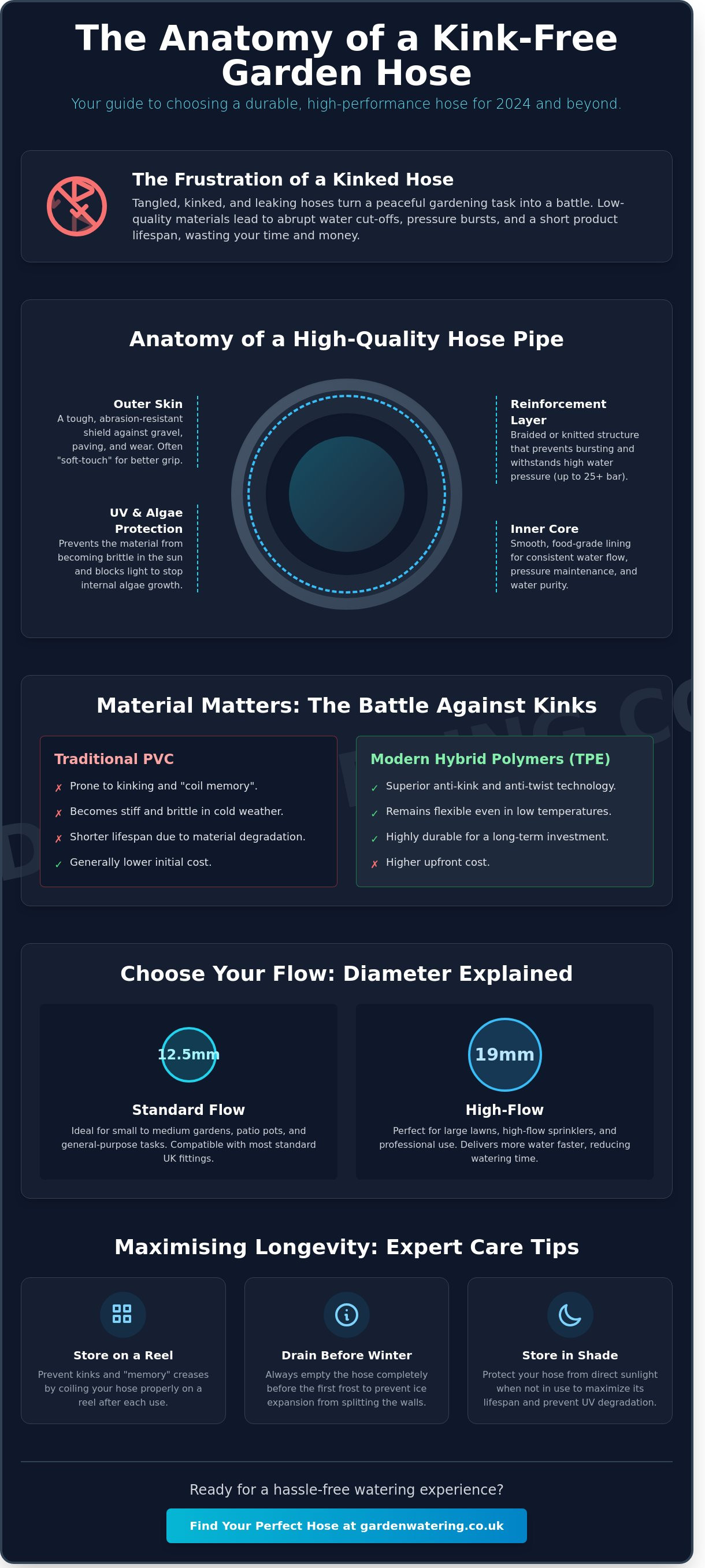
A high-quality hose pipe is a flexible, multi-layered conduit engineered to transport water under pressure without failing. While it looks simple from the outside, the internal garden hose construction involves complex engineering to ensure longevity and performance. The inner core provides the essential foundation for water flow, and its smooth surface reduces friction to maintain consistent pressure at the nozzle. This inner layer must be robust enough to handle the expansion that occurs when the water is turned on, yet flexible enough to coil easily without permanent deformation.
To better understand this concept, watch this helpful video:
The Secret of Multi-Layer Construction
Standard 3-layer hoses serve as the entry-level benchmark for British gardens, offering a basic balance between cost and durability. For professional applications or larger landscapes, 5-layer or 6-layer premium hoses provide superior kink resistance and handle water pressures exceeding 25 bar. Braided reinforcement is the key to high-pressure resistance. These internal structures, whether braided or knitted, prevent the hose from expanding or bursting under the strain of high-flow irrigation systems, ensuring the product maintains its shape over a 10-year or 15-year lifespan.
UV Stabilisation and Algae Protection
Sunlight is a primary enemy of outdoor equipment in the UK. UV-resistant layers are essential because they prevent the PVC or rubber from becoming brittle and cracking after a single hot summer. Opaque internal layers are equally vital; they block light to stop internal algae growth, which can otherwise clog your Hozelock watering tools. If you use your hose pipe to fill garden ponds or paddling pools, it's vital to choose "food-grade" materials that don't leach chemicals into the water supply.
The outermost skin acts as a protective shield. It's designed to withstand constant abrasion against sharp gravel, stone walls, and garden paving. High-quality external skins often feature a "soft touch" texture, making the hose easier to grip in wet weather while providing the toughness required for heavy-duty use. Choosing a hose with a high-density outer layer ensures that dragging it across a patio won't lead to pinhole leaks or structural failure, protecting your investment for many seasons to come.
The Battle Against Kinks: Materials and Construction Techniques
Kinks are more than just a minor annoyance; they are the primary cause of structural failure in a garden hose pipe. When a hose folds over itself, it creates a weak point in the material that eventually leads to splits or permanent "memory" creases. This physical phenomenon usually happens because low-quality PVC lacks the structural integrity to maintain its shape under tension. Cheap plastics have a high memory effect, meaning they naturally want to return to the tightly coiled shape they held on the shop shelf. When you pull the hose across your lawn, the material resists straightening, causing the walls to collapse inward and cut off your water supply.
To solve this, manufacturers have moved away from basic PVC toward hybrid polymers and Thermoplastic Elastomers (TPE). These modern materials offer a significant advantage because they remain flexible even when temperatures drop toward zero degrees. A high-quality hose typically features a multi-layer construction, often consisting of four or five distinct layers. The core provides a smooth path for water, while the outer layers protect against UV damage and abrasion. Experts often recommend looking for kink-resistant materials that balance wall thickness with weight, as a hose that is too heavy becomes a chore to move around the garden.
Why Do Hose Pipes Kink and Twist?
Most kinking issues stem from thin-walled construction and poor storage habits. If a hose pipe has thin walls, it lacks the internal pressure resistance to stay cylindrical when bent. Temperature also plays a vital role; budget plastics become brittle in winter and overly soft in summer, both of which encourage twisting. You can identify a superior product by its texture and weight. A premium hose feels substantial and has a slightly ribbed or "grippy" surface, whereas a low-quality version feels oily or thin. If you want to dive deeper into specific product recommendations, check out our Ultimate Guide to Choosing the Best Garden Hose for more specialist advice.
Advanced Anti-Kink Solutions
Leading brands like Hozelock have revolutionised hose design with "tricoflex" technology. This involves a specific knitted reinforcement layer that allows the hose to bend without twisting or knotting. These non-torsion systems ensure that water pressure remains constant, even if the hose is pulled around sharp corners or garden furniture. Many of these professional-grade hoses also feature "soft-touch" textures. This provides a secure grip when your hands are wet and helps the hose glide smoothly over grass without snagging. If you are tired of fighting with your current equipment, you might want to upgrade to a professional-grade hose to make your daily watering routine much more efficient.
Choosing the Right Diameter and Length for Your Garden
Selecting the correct hose pipe involves more than just picking the longest one on the shelf. At Garden Watering, we've spent over 15 years helping gardeners understand that the physical dimensions of your equipment directly impact the health of your plants. If the diameter is too narrow or the length is excessive, your sprinklers won't provide the even coverage your lawn requires to thrive. We specialise in providing expert advice to ensure your irrigation setup is both efficient and easy to manage.
12.5mm vs. 19mm: Which Diameter Do You Need?
The 12.5mm (1/2 inch) hose is the standard for most UK domestic gardens. It's lightweight and provides ample pressure for hand-watering flowerbeds or using a basic spray gun. However, if you're running professional irrigation systems or high-flow oscillating sprinklers, a 19mm (3/4 inch) diameter is essential. This larger size delivers significantly more water volume, which is vital for maintaining pressure over long distances. Flow rate decreases by roughly 10% for every 10 metres of hose.
Calculating the Perfect Length
Avoid the temptation of "over-reaching" by buying a 50-metre hose for a 20-metre garden. Excess length creates friction, which leads to a noticeable drop in water pressure at the nozzle. We recommend using the "Rule of 10": measure the distance to the furthest corner of your garden and add 10% extra to account for corners, bushes, and garden furniture. If you're managing a larger estate, you can use high-quality hose pipe connectors to join multiple lengths together only when needed. This keeps your primary hose manageable and light for daily tasks.
Precision measurement is the first step toward a lush, healthy garden. To plan your route effectively, follow these specialist tips:
- Measure with a string: Lay a piece of string along the exact path you intend to take, weaving around permanent obstacles like sheds or ponds.
- Consider the weight: A 30-metre hose full of water is significantly heavier than an empty one. If mobility is a concern, consider two shorter hoses joined by a leak-proof coupling.
- Check your tap pressure: High-flow 19mm hoses require a strong mains pressure to function at their peak.
Understanding these technical aspects helps with proper hose maintenance and care, as it prevents you from over-stretching the material or forcing water through an incompatible system. By matching the diameter to your specific tasks and keeping the length precise, you ensure your garden receives the exact hydration it needs without wasting water or effort.
Hose Reels, Connectors, and System Compatibility
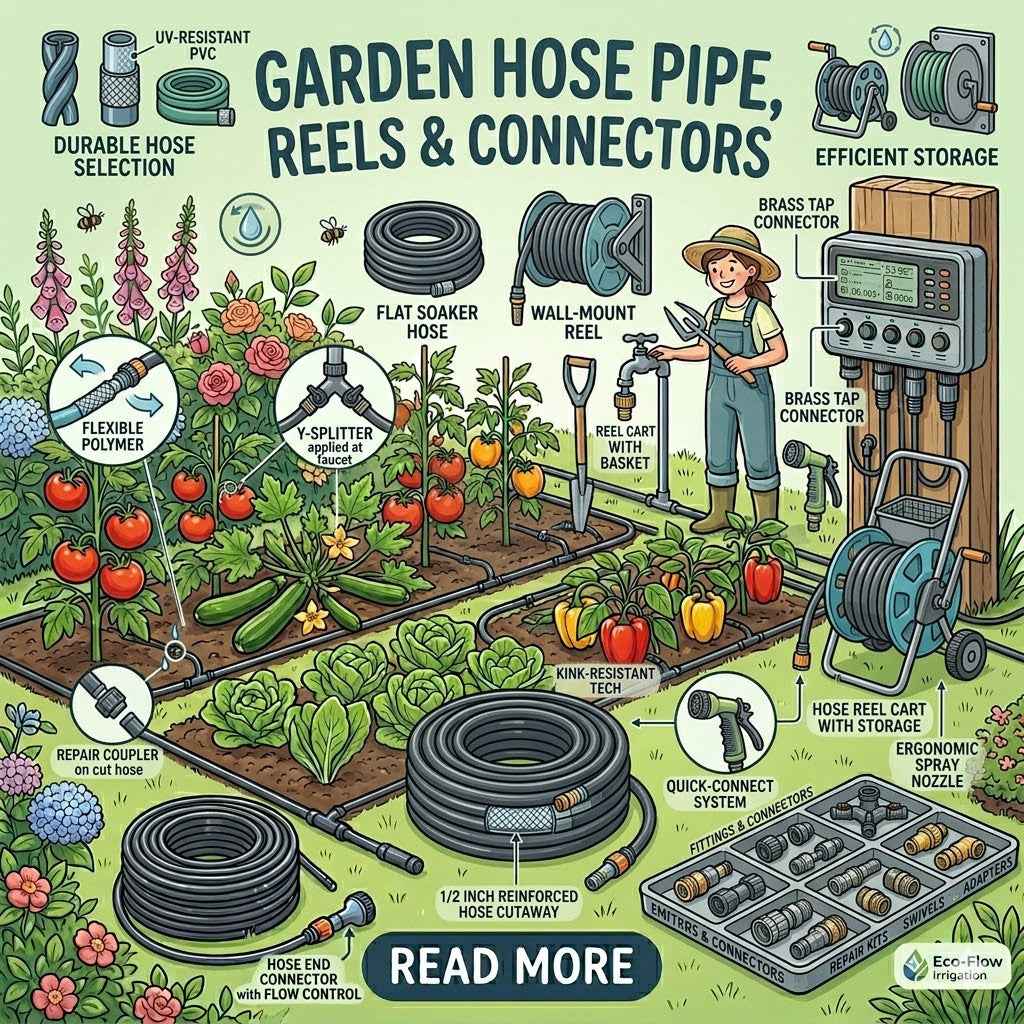
A high-quality hose pipe is only as effective as the system supporting it. Without proper storage and secure connections, even the most durable pipe will suffer from kinks, tangles, and premature wear. We've spent over 15 years specialising in irrigation to understand that the relationship between the pipe and its reel determines the longevity of your setup. In the United Kingdom, most outside taps follow a standard G1/2 inch or G3/4 inch BSP thread. A reliable starter set, featuring a threaded tap adaptor, a hose end connector, and an AquaStop connector, ensures your system is watertight from the moment you turn on the valve. This universal compatibility is the foundation of an efficient garden.
Manual vs. Automatic Hose Reels
Wall-mounted auto-reels provide a sleek, professional finish to any garden. These units use an internal spring to retract the hose smoothly, which prevents the pipe from being left out in the sun where UV rays degrade the material. If you manage a larger property, a free-standing cart is often the better choice. Carts provide the mobility to reach distant borders that a fixed reel cannot. We've found that for gardens exceeding 150 square metres, a wheeled cart reduces physical strain significantly. You can read our detailed findings in our Hozelock Hose Reels review.
The Importance of Quality Connectors
Connectors are the most frequent point of failure in a watering system. Standard plastic fittings can become brittle and crack after 24 months of exposure to British weather. We recommend considering premium connectors with internal metal components for high-pressure environments. The AquaStop feature is particularly useful; it contains an internal valve that halts water flow when an attachment is disconnected. This means you can swap from a spray gun to a lawn sprinkler without getting wet or walking back to the tap. To find the right tools for your garden, browse our range of Hozelock spray guns and lances.
Transitioning from manual watering to automatic watering systems is a logical step for many homeowners looking to improve efficiency. By integrating a water timer with your hose pipe, you can deliver precise hydration to your plants at dawn or dusk. Data from 2024 installations suggests that automated systems can reduce domestic water consumption by up to 45% while ensuring plants thrive during dry spells. This shift moves your garden from a chore-heavy space to an efficiently managed environment, allowing you to enjoy the results without the daily effort.
Maximising Longevity: Maintenance and Winter Care
A high-quality hose pipe can easily serve your garden for over 10 years if you follow a few simple maintenance rules. Most equipment failures aren't caused by manufacturing flaws; they happen because of how the hose is treated during the off-season. Neglect leads to brittle plastic, cracked inner linings, and leaky fittings that waste water and money.
The absolute primary cause of hose failure is leaving water inside the line during a hard frost. When water freezes, it expands by approximately 9% in volume. This internal expansion creates immense pressure that can split reinforced PVC walls or cause the outer layers to delaminate. Once the structure is compromised, the hose will likely burst the next time you turn on the tap.
Winterising Your Garden Hose Pipe
Winterising your equipment should be a priority before the first UK frost, which typically arrives between late October and mid-November. Follow this straightforward routine to protect your investment:
- Drain the line: Disconnect the hose from the tap and the spray gun. Hold the hose high and walk its entire length to let gravity push all remaining water out.
- Remove tap connectors: Always unscrew the connector from the outdoor tap. If left on, water can become trapped between the fitting and the tap body, freezing and potentially splitting your external pipework or the tap itself.
- Store indoors: Move your coiled hose into a shed, garage, or cellar. Keeping it away from the freeze-thaw cycle prevents the material from becoming brittle.
When coiling for storage, avoid tight loops. Large, loose coils prevent "memory" issues where the hose pipe becomes permanently deformed and refuses to lie flat in the spring. If you use a reel, wind it steadily to ensure the hose doesn't overlap unevenly, which can cause kinks.
Routine Maintenance and Quick Fixes
Routine care keeps your system running at peak efficiency. Every few months, wipe down the exterior with a damp cloth and mild detergent. This removes grime and mould that can eat away at the UV-protective coating, helping to maintain the bright external colour of your equipment. It's also a good time to inspect your O-rings and rubber washers. These small components often perish after 2 or 3 seasons; replacing them costs mere pence and immediately stops those annoying drips at the connection point.
If you do suffer a split or a puncture, you don't need to replace the entire length. You can use a hose joiner to cut out the damaged section and reconnect the two healthy ends. For advice on selecting the right parts for a repair, our hose pipe connector guide provides a clear breakdown of which fittings suit your specific setup.
Finally, consider the layout of your garden. Accidental damage from lawnmowers and hedge trimmers accounts for roughly 15% of the repairs we see. Using a wall-mounted or portable reel doesn't just keep the garden tidy; it ensures your hose stays safely out of the path of sharp blades and prevents it from becoming a trip hazard for your family.
Equip Your Garden for Success in 2026
Selecting a high-quality hose pipe isn't just about convenience; it's about ensuring your plants get the hydration they need without the frustration of tangles or leaks. We've explored how modern multi-layered construction and anti-kink technologies have transformed garden maintenance. By matching the right diameter to your specific water pressure and committing to simple winter care routines, you can expect your equipment to perform reliably for many seasons. These small decisions today prevent wasted water and unnecessary replacements in the future.
We've spent over 15 years specialising exclusively in irrigation, so we know that the right tools make all the difference to your garden's health. Our team provides specialist Hozelock advice you can trust to help you find the perfect setup for your unique outdoor space. We also offer free UK delivery on all orders over £75 to help you get your new system up and running without extra cost. Your garden deserves the best care, and with a professional-grade system in place, you'll enjoy a lush, healthy landscape all year round.
Explore our expert-selected range of Hozelock Hose Pipes and Reels
Frequently Asked Questions
What is the best type of hose pipe for a small UK garden?
For a small UK garden, a wall-mounted retractable reel or a compact 15-metre hose pipe is the most efficient choice. These systems keep your outdoor space tidy and prevent tripping hazards by automatically rewinding the hose after use. A 15-metre length typically covers a standard 50-square-metre terrace or patio without leaving excess coils on the ground.
Can I use any brand of connector with a Hozelock hose pipe?
You can use most major brands of connectors with a Hozelock hose pipe because they almost all follow the universal 12.5mm quick-connect standard. Brands like Claber and Gardena are fully interchangeable with Hozelock fittings. We recommend using high-quality brass or glass-fibre reinforced plastic connectors to ensure a leak-free seal that lasts for over 500 connection cycles.
How do I stop my hose pipe from kinking?
To stop your hose pipe from kinking, you should choose a model with a high-quality braided or knitted reinforcement layer. These multi-layered designs, often featuring 4 or 5 layers, provide the structural integrity needed to resist twisting. Storing your hose on a circular reel rather than hanging it over a single hook also helps maintain its shape and prevents internal collapses.
Is a 19mm hose pipe better than a 12.5mm one?
A 19mm hose pipe is better if you need to move large volumes of water over distances exceeding 30 metres or if you have low mains pressure. The wider diameter reduces friction loss, which can increase water delivery by up to 50 percent compared to a standard 12.5mm hose. Most UK domestic gardens find the 12.5mm version sufficient for standard spray guns and sprinklers.
What is an expandable hose pipe and are they any good?
An expandable hose pipe is a lightweight tube that grows up to three times its original length when filled with water pressure. These are excellent for gardeners with limited storage or those who find traditional reels too heavy to lift. While convenient, they are generally less durable than PVC hoses, so ensure you choose one with a triple-layer latex core to prevent punctures.
How long should a quality garden hose pipe last?
A high-quality garden hose pipe should last between 10 and 20 years if it's maintained correctly. Premium models often come with a 20-year or 30-year guarantee from the manufacturer, reflecting their UV resistance and burst pressure ratings of over 30 bar. Cheaper, single-layer hoses may fail within 2 years due to sun damage or internal splitting.
Can I leave my hose pipe outside during the winter?
Why is my hose pipe losing water pressure at the nozzle?
Pressure loss at the nozzle is usually caused by a kink in the line or a build-up of limescale in the spray head. Check the entire length of the hose for twists and inspect the rubber O-rings on your connectors for signs of wear. Replacing a 50p O-ring or soaking the nozzle in a descaling solution often restores the full flow immediately. For homeowners dealing with persistent mineral buildup, Your Water Guy provides expert guidance on how professional water softener systems can protect your entire property's plumbing and outdoor equipment.
`-
Posted in
hose pipe