Hozelock Drip Irrigation: The Complete 2026 Guide to Efficient Watering
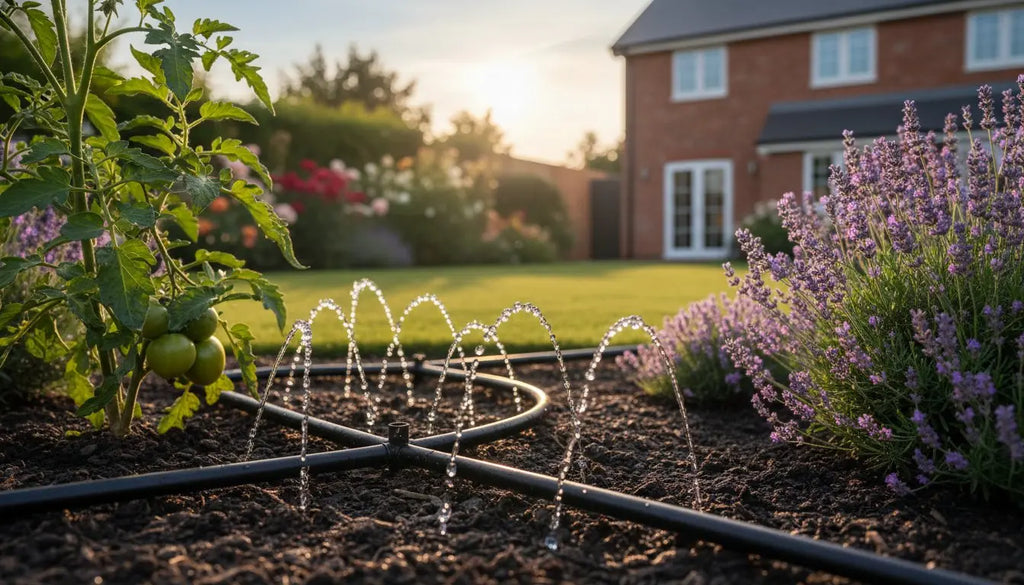
Did you know that a hozelock drip irrigation system can reduce your garden water consumption by up to 90% compared to a traditional hosepipe? It's a remarkable statistic that highlights the hidden waste in manual watering methods. Most gardeners agree that there's nothing more frustrating than spending hours with a hose only to see plants wilt during a heatwave, or worrying about your flowerbeds while you're away on holiday. You want a lush, thriving garden and lower water bills, but the technical details of pipe sizes and connectors often feel overwhelming.
We've designed this guide to help you master the art of precision gardening. You'll learn exactly how to plan, select, and install a system that provides consistent hydration without the effort. We will walk you through the modular components and setup steps required to create a durable solution for your specific landscape. By following these expert steps, you can ensure your garden stays healthy and vibrant throughout 2026 and beyond.
Key Takeaways
- Understand the mechanics of root-level watering and why it is significantly more efficient than using a standard hose.
- Learn to map your garden into specific zones to provide tailored hydration for everything from boundary hedges to delicate flower beds.
- Identify the ideal hozelock drip irrigation kit for your needs, ensuring you have the right connectors and pressure reducers from the start.
- Gain practical tips for a seamless installation, including how to prepare pipes for easier fitting and where to hide them for a tidy finish.
- Discover how to adapt your system for high-demand areas like greenhouses and vegetable patches using specialized drippers and micro-jets.
What is Hozelock Drip Irrigation and Why is it the UK Standard?
Hozelock drip irrigation represents a shift from broad, wasteful watering to a method of high precision. At its simplest, drip irrigation involves delivering water slowly and directly to the plant roots through a network of pipes and emitters. This approach ensures that moisture doesn't just sit on the leaves or evaporate in the sun. Instead, it penetrates the soil exactly where the plant can absorb it. For UK gardeners, this has become the gold standard because it addresses the unpredictability of our seasons while maintaining a lush landscape.
The efficiency of this system is its most compelling feature. Research shows that using a targeted setup can reduce water consumption by up to 90% when compared to a traditional hosepipe. This isn't just about lower bills; it's about responsible gardening in an era where local water authorities often monitor usage closely. Hozelock has built its reputation on creating components that withstand the variable UK climate, from frost-resistant pipes to UV-stable connectors. Because the system is modular, you can start with a small kit for a few pots and expand it as your garden grows over the years.
To better understand this concept, watch this helpful video:
The Core Benefits of Automatic Drip Watering
Plants thrive on consistency. When you use a hozelock automatic watering system, you replace the "flood and drought" cycle of manual watering with regular, small doses of hydration. This steady supply prevents soil from becoming baked and hydrophobic, which often causes runoff during heavy rain. Beyond the health of your plants, the convenience is unmatched. You can enjoy your summer holidays without the stress of returning to a brown lawn or dead flowerbeds. It truly is a "set and forget" solution for the modern gardener.
How the Hozelock Ecosystem Works
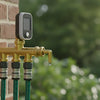
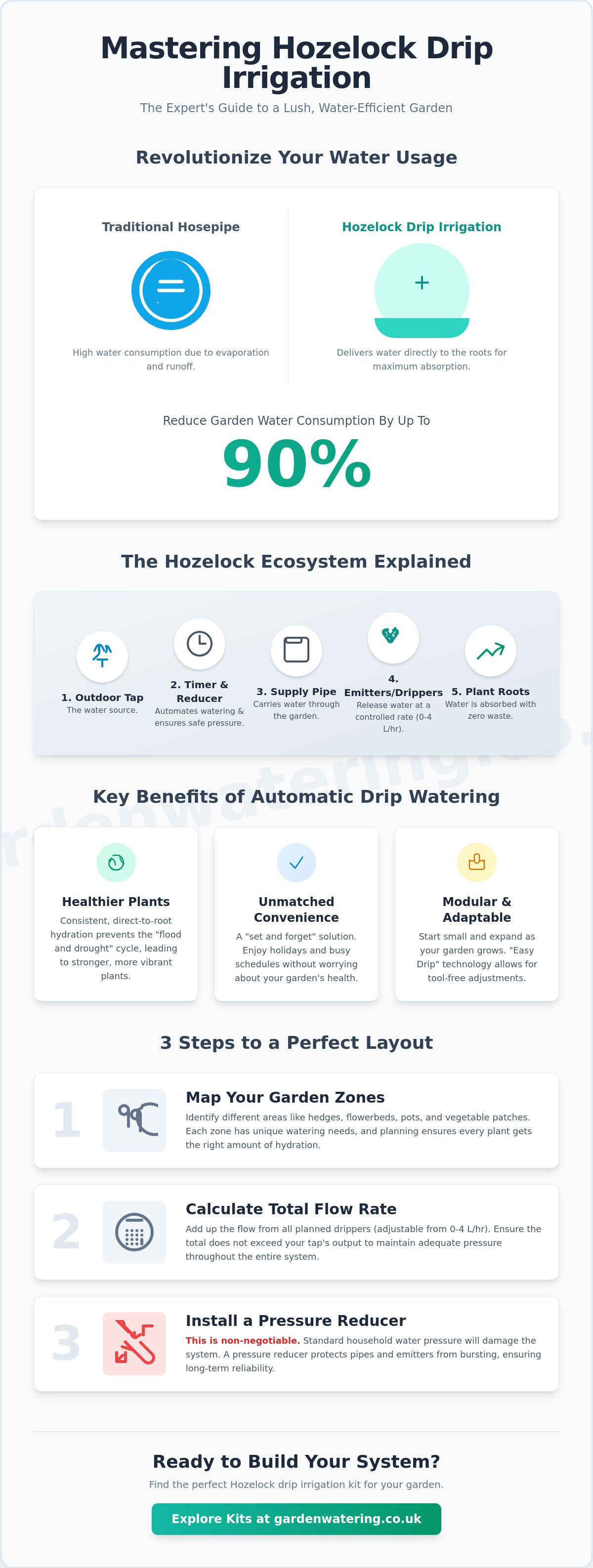
The journey of water through the system is logical and efficient. It begins at your outdoor tap, passes through a pressure reducer and a timer, and then travels through a supply pipe to individual emitters. Hozelock's "Easy Drip" technology is a standout feature for those who prefer a straightforward setup. It allows for tool-free installation, meaning you can reposition drippers as your planting layout changes without needing professional help. This flexibility is vital for UK soil types, allowing you to adjust flow rates between 0 and 4 litres per hour to suit heavy clay or fast-draining sandy borders. This adaptability makes hozelock drip irrigation the preferred choice for gardeners across the British Isles.
Planning Your Layout: From Tap Connectors to Borders
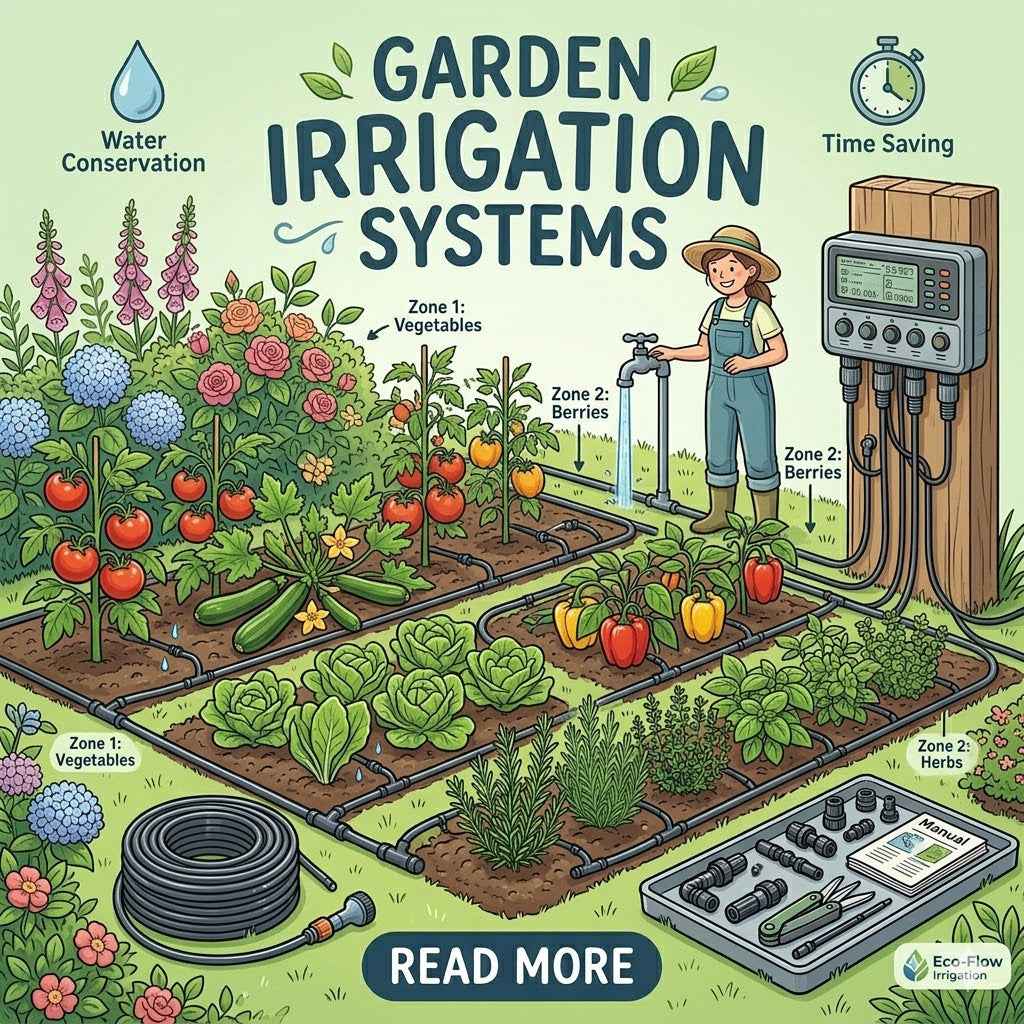
Successful hozelock drip irrigation relies on a logical layout rather than a collection of random parts. Before you unroll any pipe, you must identify your garden's specific watering zones. A row of established laurel hedges requires a different volume of water than a cluster of terracotta pots on a sun-drenched patio. By mapping these areas, you can ensure each plant receives the precise amount of hydration it needs without wasting a drop. For those seeking a deeper technical dive into layout principles, this Backyard Drip Irrigation Guide provides excellent foundational advice for DIY setups.
Calculating your system's capacity is the next vital step. A standard garden tap provides a finite amount of water per minute. Since Hozelock drippers are adjustable between 0 and 4 litres per hour, you need to add up the total flow of all planned emitters. If the total exceeds your tap's output, your system will suffer from low pressure, leaving the plants at the end of the line thirsty. If you're unsure where to begin with your map, exploring some design ideas and plans can help you visualize the most efficient route for your pipework.
The Role of the Pressure Reducer
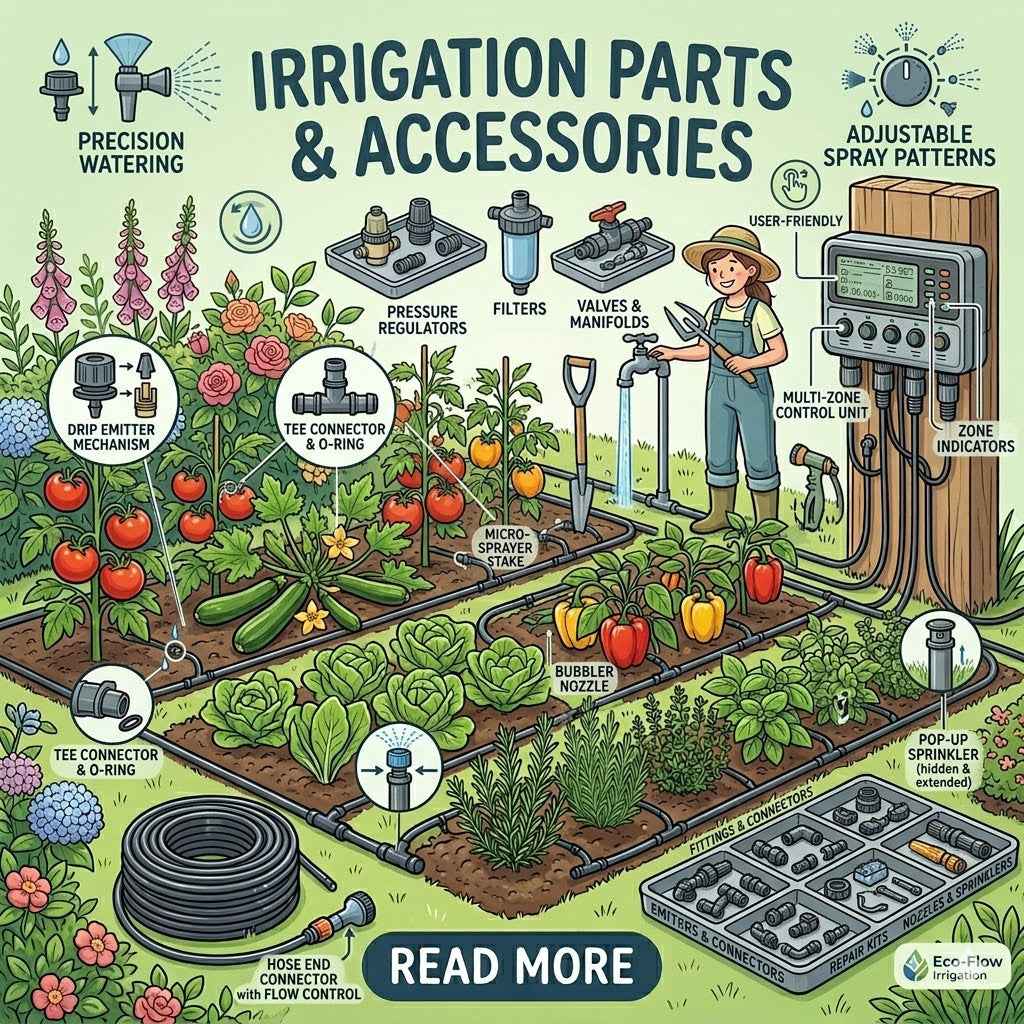
Standard household water pressure is usually far too high for a delicate drip system. High pressure can cause emitters to pop off or pipes to burst at the joins. A pressure reducer is a non-negotiable component that sits at the start of your system, bringing the flow down to a manageable level. This ensures a consistent, even drip from the first plant to the last. Choosing the right Hozelock Connectors and reducers at the tap end is your first priority for a leak-free experience.
Choosing Your Pipework: 13mm vs 4mm
Think of your pipework as a network of arteries and veins. The 13mm supply pipe acts as the main artery. It carries the bulk of the water over long distances, such as the length of a flower border or across a lawn. The 4mm micro pipe acts as the veins, branching off the main line to reach individual pots or specific plants. To maintain efficiency, keep these rules in mind:
- 13mm Mainline: Best for runs up to 50 metres in a single direction.
- 4mm Branch Lines: Keep these short, ideally under 2 metres, to prevent pressure drops.
- Strategic Loop: For large areas, consider a "ring main" layout to balance the pressure across the entire network.
By following this "Mainline vs. Branch" strategy, you create a robust hozelock drip irrigation network that provides uniform watering across your entire outdoor space.
Choosing the Right Hozelock Drip Kit for Your Needs
Selecting your first hozelock drip irrigation setup doesn't have to be complicated. For most beginners, pre-packaged kits provide a foolproof entry point into precision gardening. These kits include all the essential components, such as pressure reducers, supply hoses, and drippers, ensuring that every part is compatible right out of the box. While experienced gardeners might eventually prefer building a custom system from individual components to suit a complex landscape, a kit allows you to see the results of efficient watering immediately without the stress of technical planning.
Determining when to skip the kit depends on the scale of your project. If you have a standard garden with a few borders or a patio full of pots, a kit is almost always the most cost-effective and straightforward choice. However, if your garden features dozens of distinct zones or covers a very large acreage, you might find it better to buy bulk components. This allows you to tailor the exact number of emitters and pipe lengths to your unique space. For most UK households, the convenience of a ready-made solution outweighs the effort of a completely bespoke build.
The Universal Kit vs. The 20-Pot Kit Plus
Choosing between these two popular options depends entirely on what you're growing. The Universal Kit is engineered for large borders and established shrubbery. It uses Universal Emitters that can be pierced directly into the 13mm supply pipe, making it incredibly versatile for wide areas. In contrast, the 20-Pot Kit Plus is designed for precision. It relies on 4mm micro-drippers and micro-pipe to deliver water to individual containers or hanging baskets. You can explore the full range of Hozelock Watering Kits to find the configuration that matches your current layout.
Essential Add-ons: Water Timers and Controllers
A drip system only reaches its full potential when you pair it with a reliable water timer. Without automation, you're still tied to the tap, which defeats the primary "set and forget" benefit of the system. Modern sensor controllers are particularly effective because they use daylight sensors to trigger watering at sunrise or sunset. This is the optimal time for plants to absorb moisture before the midday sun causes evaporation or wind carries the water away.
By automating your hozelock drip irrigation, you ensure your garden receives a consistent supply of water regardless of your schedule. For a deep dive into choosing the right model for your garden, refer to our Guide to Hozelock Water Timers. These controllers often feature manual override buttons, giving you total flexibility if you need to add a little extra water during particularly dry spells in the height of summer.
Step-by-Step Installation & Professional Maintenance
Installing your hozelock drip irrigation system is a rewarding process that bridges the gap between planning and a self-sustaining garden. To begin, use the "warm water trick." Cold pipes are often stiff and difficult to push onto connectors. By dipping the ends of your 13mm and 4mm pipes into a thermos of warm water for a few seconds, you make the plastic supple. This ensures a deep, secure fit that won't leak under pressure, saving you from sore fingers and loose joins.
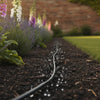
When laying out your pipework, you face a choice between aesthetics and accessibility. Laying pipes on the surface is practical for vegetable patches where you might change layouts annually. For ornamental borders, many gardeners prefer to hide the pipes under a layer of bark mulch. If you choose this route, use stakes and clips every metre to prevent "pipe creep." This phenomenon occurs as the plastic expands and contracts with temperature changes, which can gradually shift your drippers away from the plant roots if they aren't anchored properly.
Before you fit the final end caps or emitters, you must flush the system. Turn on the water and let it run through the open pipes for a minute. This simple step clears out any grit or plastic shavings that may have entered the lines during the cutting process. Once the water runs clear, you can securely fit your components. If you find you've made a mistake or need to extend a line, you can find the necessary irrigation fitting adaptors to modify your setup without starting from scratch.
Maintenance: Keeping the Flow Consistent
A high-performing system requires minimal but regular attention. Spend five minutes once a month walking your lines while the water is running. Look for puddles that indicate a loose join or dry spots that suggest a blocked dripper. Over time, lime-scale or fine dirt can clog emitter heads. You can usually clear these by gently rubbing the rubber nozzle or soaking the head in a mild descaling solution. For the best results, browse our latest hozelock automatic watering systems to ensure your components are up to date.
Winterising Your Hozelock System
The UK's winter frosts can be devastating to technical components if they aren't prepared correctly. You don't need to dig up your pipes, but you must protect the valves. Follow the "Drain and Disconnect" method: remove your water timer from the tap and bring it indoors. Freezing water inside the internal valves will crack the plastic housing. Always remove the batteries to prevent corrosion over the damp winter months. Similarly, disconnect your pressure reducer and store it in a dry shed. Leaving the main pipework in the garden is safe, provided you've opened the end caps to let standing water drain away.
Advanced Drip Strategies: Greenhouse & Veg Patches
Transitioning from basic border watering to managing high-demand areas like vegetable patches requires a more nuanced approach. Vegetable crops have diverse hydration needs that change as they move from seedlings to harvest. For instance, deep-rooting plants like tomatoes and courgettes thrive with adjustable drippers placed at the base of each stem. In contrast, dense rows of carrots or salad leaves are better served by incorporating soaker hoses into your network. This combination ensures that every crop receives moisture in the most effective format, preventing the soil from drying out during critical growth phases.
Scaling your hozelock drip irrigation system is straightforward thanks to its modular design. If your garden expands, you don't need to start over. You can simply add a multi-way tap manifold to create independent watering zones. This allows you to set different schedules for your thirsty vegetable beds and your established flower borders. By using a mix of 13mm supply pipes for the main runs and 4mm micro-pipes for the final delivery, you maintain the pressure balance needed for a large-scale setup.
Greenhouse Watering Solutions
Greenhouses create a unique micro-climate where heat management is just as vital as hydration. Traditional overhead spraying often leads to leaf scorch or fungal issues because water sits on the foliage in the humid air. A hozelock drip irrigation setup solves this by delivering water directly to the pots, keeping the leaves dry. If your greenhouse has tiered shelving, run 4mm micro-pipes vertically to reach every level. For plants that require high humidity, consider swapping standard drippers for micro-jets. These provide a fine mist that cools the air without saturating the soil. For more technical layouts, our design ideas and plans offer specific blueprints for glasshouse environments.
Why Garden Watering is Your Hozelock Specialist
We bring over 15 years of dedicated UK-based expertise to every customer interaction. Unlike generalist retailers, we focus exclusively on technical watering systems, providing the deep product knowledge required to solve complex garden challenges. We understand how these components perform in the British climate and offer the reliable support you need to build a system that lasts. Our role is to be your partner in creating a healthy, water-efficient landscape that thrives with minimal effort.
Investing in the right equipment is the final step toward a self-sustaining garden. We invite you to explore our full Hozelock Watering range to find the perfect components for your project. Whether you are starting with a simple kit or designing a multi-zone professional network, we have the specialized tools to help you succeed.
Achieve a Self-Sustaining Garden Today
Mastering hozelock drip irrigation is about more than just saving water; it's about giving your plants the exact care they need to thrive. By mapping your garden into distinct zones and selecting the right modular components, you create a system that grows alongside your landscape. Remember that consistency is the secret to a lush garden. Automating your setup ensures your plants remain vibrant even during the driest summer months or while you're away on holiday.
As an official UK Hozelock Specialist with over 15 years of irrigation expertise, we're here to help you succeed. You can access our expert layout advice and detailed design plans to ensure your installation is perfect from day one. We've helped thousands of gardeners transition to smarter watering solutions that stand the test of time. Shop the full Hozelock Drip Irrigation range at Garden Watering to start your journey toward a more efficient and effortless garden. With the right tools and a little planning, you'll enjoy a beautiful, healthy outdoor space all year round.
Frequently Asked Questions
Can I use a Hozelock drip system with a water butt?
Yes, you can use a water butt, but gravity flow is rarely sufficient for a complex hozelock drip irrigation network. You'll need to install a specific water butt pump to provide the necessary pressure for the emitters to function. This ensures that even the plants at the end of your line receive a consistent supply of water without the system sputtering or failing. It's an excellent way to stay sustainable while maintaining precision.
How many drippers can I run off a single Hozelock tap timer?
You can typically run between 30 and 40 adjustable drippers from a single timer, provided your mains pressure is standard. Each 4LPH dripper adds to the total demand on your tap. If you notice the flow weakening at the end of your pipe, you've likely exceeded the capacity. In these cases, it's best to split your garden into two separate zones with independent timers to maintain uniform hydration.
Will a Hozelock drip system work with low water pressure?
A hozelock drip irrigation system performs best with a pressure reducer attached to a standard mains tap. If your household pressure is naturally low, the system may still work, but you'll need to limit the length of your pipe runs. Avoid long 4mm branches and keep the 13mm mainline as short as possible to prevent further pressure loss before the water reaches your plants. Keeping the layout simple helps maintain flow.
Do I need a special tool to install Hozelock Easy Drip emitters?
You don't need any specialized tools to install the Easy Drip range. The emitters feature a sharp, integrated spike that pierces the supply pipe as you click them into place. This clever design makes it easy to reposition your watering points as your garden matures. While you might use a pair of garden shears to cut the pipe to length, the assembly itself is entirely tool-free and designed for simplicity.
How long should I set my Hozelock drip system to run for each day?
Most gardens thrive with a daily run time of 20 to 30 minutes, ideally scheduled for early morning. This allows the soil to absorb moisture before the sun reaches its peak. During a heatwave, you might increase this to 45 minutes or add a secondary short burst in the evening. Always check the soil moisture levels near your roots to ensure you aren't over-watering, as every plant species has different needs.
Can I mix and match Hozelock drip parts with other brands?
You can technically use standard 13mm and 4mm tubing from other manufacturers, but we recommend sticking to genuine Hozelock connectors. The proprietary click-fit system is engineered for a precise, leak-free seal that other brands may not match. Using mismatched parts often leads to "pop-offs" when the pressure builds up. This can result in wasted water and thirsty plants, so staying within the ecosystem is the most reliable choice.
What happens to the drip system during a hosepipe ban in the UK?
Regulations during a UK hosepipe ban depend entirely on your local water authority's specific rules. In many cases, automated drip systems are granted exemptions because they are significantly more efficient than manual hoses. However, you must check your supplier's website for current "Temporary Use Bans." Violating a ban can result in a fine of up to £1,000, so staying informed is essential for every responsible gardener during dry spells.
How do I stop my Hozelock drippers from getting blocked?
Preventing blockages starts with installing an inline filter at the beginning of your system to catch sediment. If you live in a hard water area, lime-scale can also build up inside the emitters over time. You can clear most blockages by gently twisting the adjustable head or soaking it in a mild descaling solution. Regularly flushing the mainline through the end caps will also help remove any trapped debris before it reaches your plants.
`-
Posted in
DIY Gardening, Drip Irrigation, Efficient Watering, Garden Installation, Gardening Tips, Hozelock, hozelock drip irrigation, Water Conservation, Watering Systems