
Smart Wifi Tap Irrigation Timers, How do they work

Imagine landing back home after a relaxing holiday only to find your prize-winning plants have turned into brittle, brown sticks. It's a common heartbreak for gardeners, but it's also entirely preventable. We all want a vibrant, healthy garden, but the stress of manual watering or wondering if a basic mechanical clock will fail during a heatwave is a burden you don't need. Perhaps you are already researching a wifi garden timer, cloud timer, wireless timer, or smart irrigation timer to solve the problem of sprinklers running during a downpour. You've likely felt the frustration of wasting water and money simply because your current system isn't smart enough to check the local forecast.
This article will help you choose the ideal controller to automate your care routine and keep your landscape thriving from anywhere in the world. By installing an intelligent system, you can enjoy the precision of a "set and forget" method that responds to real-time weather data. We will explain how these devices function, how to overcome common connectivity hurdles like weak signals at the garden tap, and why pairing these controllers with Hozelock-compatible systems and ready-made drip irrigation kits is the most efficient way to lower your bills while protecting your plants.
Key Takeaways
- Learn how a wifi garden timer uses cloud-based intelligence to adjust your watering schedule automatically based on real-time local weather forecasts.
- Understand the role of WiFi Hubs and RF communication in ensuring your timer maintains a stable connection through thick external walls and across large gardens.
- Identify essential hardware features for the UK climate, including high IP ratings for waterproofing and the necessity of manual override buttons for physical control.
- Discover how to integrate your smart controller with ready-made drip irrigation kits to create a precise, water-saving system that targets the roots of your plants.
- Master expert maintenance tips, including why high-quality batteries and proper winterisation are non-negotiable for long-term system reliability.
Why Upgrade to a WiFi Garden Timer? Smart vs. Traditional Irrigation
A wifi garden timer is more than just a digital tap attachment; it's a cloud-connected valve that gives you complete control over your outdoor water flow through a smartphone app. For years, gardeners relied on basic digital "egg timers" that operated on a rigid schedule regardless of the actual conditions in the soil. Moving to a smart irrigation timer represents a significant shift toward precision. These modern systems connect to your home network, allowing you to manage complex irrigation sprinkler systems with a few taps on your screen. This technology ensures your plants receive exactly what they need, exactly when they need it, providing a level of reliability that older mechanical models simply cannot match.
The Limitations of Bluetooth and Standard Digital Timers
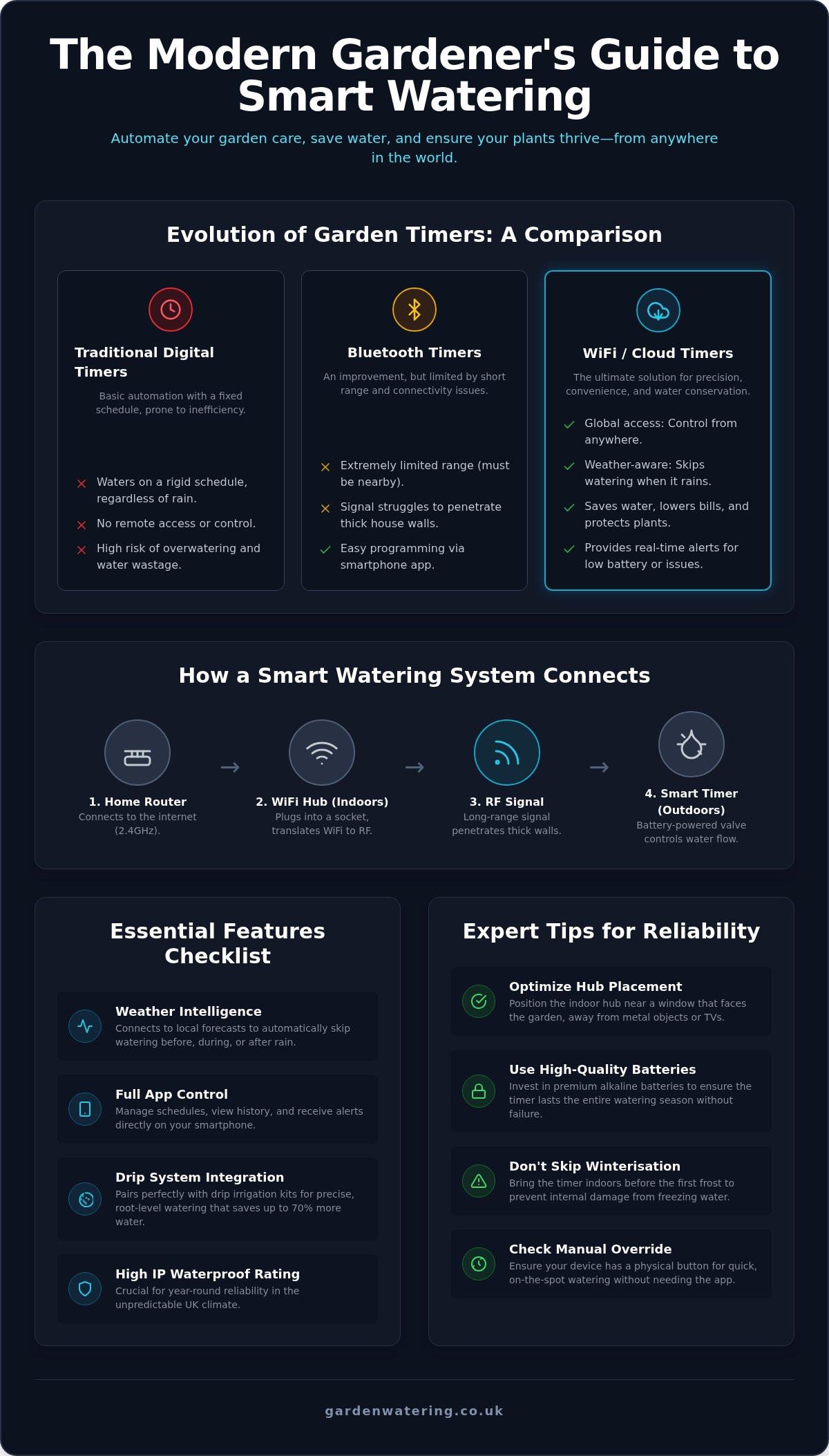
Standard digital timers often fall into the "set it and forget it" trap. While they automate the start and stop times, they're blind to the environment. If it pours with rain for three days, a traditional timer will still trigger, wasting water and potentially damaging your plants through overwatering. Bluetooth models attempted to solve the programming struggle, but they have a weakness in many UK homes: range. Bluetooth signals struggle to penetrate thick brick walls or reach the far end of a garden. A wireless timer that uses a dedicated hub avoids these frustrating connection drops. These cloud-connected devices also provide real-time alerts. You'll receive a notification if a battery runs low or a connection is lost, saving you from discovering a wilted garden after a holiday.
The Benefits of Cloud-Based Irrigation Management
The primary advantage of a cloud timer is global access. If you're sitting on a beach abroad and see a heatwave hitting the UK on the news, you can increase your watering frequency instantly. These systems also help you adhere to water conservation guidelines by using weather sensing technology. By pulling data from local forecasts, the system can automatically skip a cycle if rain is predicted. This precision leads to lower water bills and a smaller environmental footprint. Many of these garden irrigation water timers also include data logging. You can track exactly how many litres your garden consumes over a season, helping you refine your watering strategy for the long-term health of your landscape.
Understanding the Technology: Hubs, Wireless Range, and Connectivity
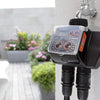
A wifi garden timer usually doesn't connect directly to your home router. Instead, it relies on a small bridge known as a WiFi Hub. This hub plugs into an indoor socket and acts as a translator between your internet connection and the valve outside. By using Radio Frequency (RF) communication rather than standard WiFi to bridge the gap to the garden, these systems can penetrate thick stone or brick walls much more effectively. If you are interested in using similar robust wireless technology for other home systems, you can discover Gem Wireless for expert wireless lighting and switching controls. This setup is crucial for maintaining a reliable link over several dozen metres. A cloud timer is a system that stores your watering schedules on remote servers, ensuring 24/7 reliability even if your phone is switched off or you lose local connectivity temporarily.
Power management is equally important for long-term performance. Most wireless timer units use high-quality alkaline batteries, which typically last an entire season. Some advanced models now feature solar-powered units to extend maintenance intervals. When choosing your hardware, look for a WaterSense labeled smart controller to ensure the technology meets high standards for water efficiency and technical performance.
Optimising Your Wireless Signal Range
Hub placement is the most common hurdle for new users. Position your internal hub in a room that faces the garden, ideally near a window. Avoid placing it inside a metal cabinet or directly behind a television; these can block the RF signal. If you have a particularly large landscape, you might need to use a mesh WiFi system to bring your home network closer to the hub's location. Most smart irrigation hardware requires a stable 2.4GHz connection. This frequency travels further and passes through obstacles better than the faster 5GHz band. If you're struggling with "dead zones," moving the hub just a few inches can often make a dramatic difference in signal strength.
Security and App Integration
Modern systems often integrate with smart home ecosystems like Alexa, Google Home, or Apple HomeKit. This allows you to use voice commands to trigger a manual watering cycle or check the system status. When setting up your app, review the permissions carefully to ensure your home network remains secure. Most reputable manufacturers use encrypted connections to protect your data. You can also share access within the app, which is perfect for letting a neighbor monitor things while you're away without giving them full administrative control. If you're looking for a reliable way to manage your outdoor space, exploring our range of SMART garden irrigation water timers is an excellent place to start.
Essential Features to Compare Before Buying a Smart Irrigation Timer
Choosing a wifi garden timer requires looking beyond just the app features. The hardware must survive the UK's unpredictable climate. Look for units with high Ingress Protection (IP) ratings, ideally IP66 or higher, to ensure they remain waterproof during driving winter rain. UV-resistant plastics are also vital. Lower-quality models often become brittle and crack after a single summer of intense sun exposure, leading to leaks and internal damage.
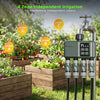
A manual override button is a non-negotiable feature for any practical gardener. If you're out in the garden and want to quickly rinse a tool or damp down a dusty path, you shouldn't have to reach for your smartphone. Similarly, consider your garden's layout. A multi-zone wireless timer allows you to set different schedules for thirsty vegetable patches and established lawns, ensuring each area receives the correct volume of water. Reliability is paramount, so look for timers with clear battery life indicators and a "fail-safe" mode. This feature ensures the internal valve automatically shuts off if the power drops too low, preventing your water from running indefinitely if the batteries fail while you're away.
Rain Delay and Weather Intelligence
The best smart irrigation timer systems use hyper-local data to perform a "Smart Skip." While basic timers might have a manual rain delay button, cloud-connected models check the forecast for your specific postcode. If the chance of rain exceeds a certain threshold, the system pauses the cycle automatically. This prevents the embarrassing scenario of your sprinklers running during a downpour. For the highest level of precision, look for systems that support soil moisture sensor integration. These sensors tell the timer exactly how damp the earth is, ensuring you never water soil that's already saturated.
Flow Meters and Usage Tracking
Monitoring your garden by time is often inefficient. Measuring water in litres rather than minutes provides a much clearer picture of your environmental impact and your plants' needs. Some high-end cloud timer models feature internal flow meters that track every drop consumed. This data is invaluable for detecting leaks. If the timer detects water flow during a period when no watering is scheduled, it can send an immediate alert to your phone. This could save you from a massive water bill caused by a burst hose or a disconnected fitting. To ensure a completely leak-free setup from the start, it's essential to use high-quality hozelock connectors throughout your irrigation network.
System Integration: Pairing Smart Timers with Drip Irrigation Kits
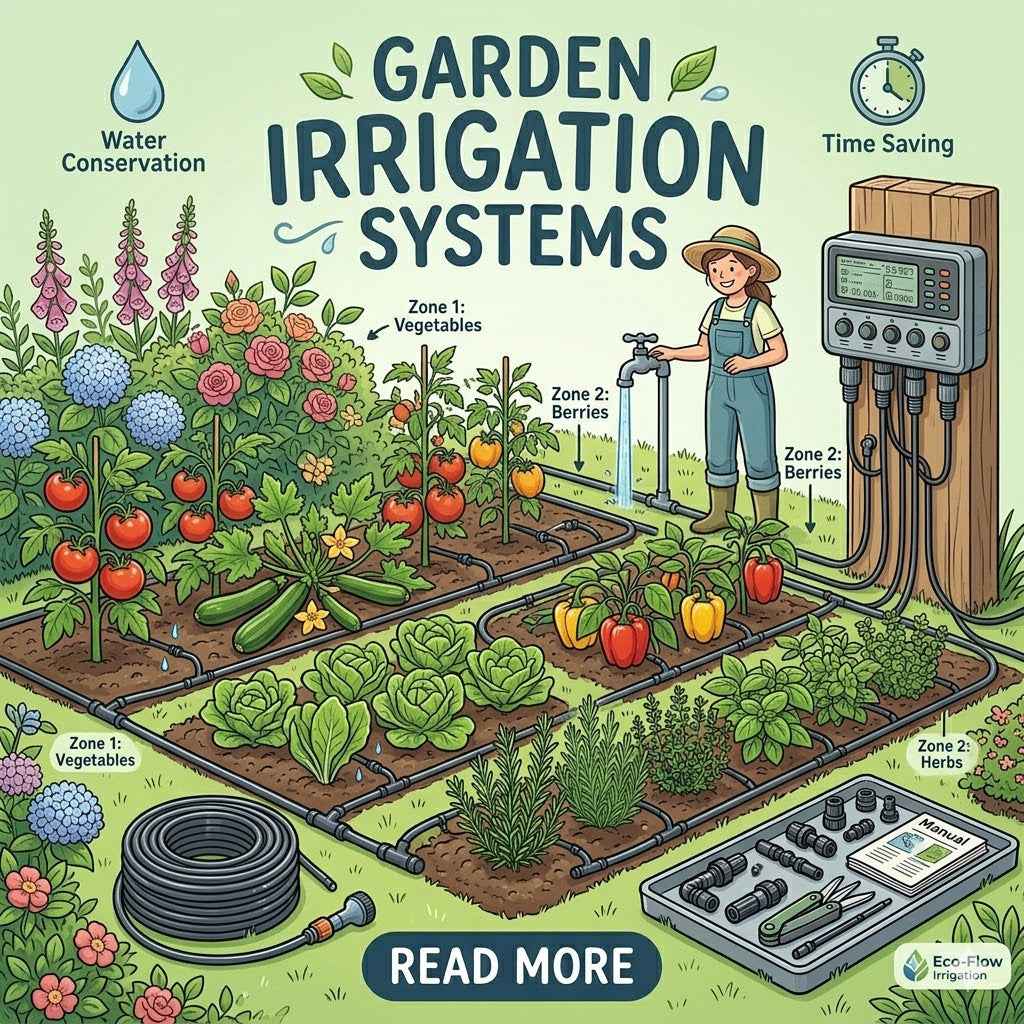
A wifi garden timer acts as the intelligent brain of your outdoor space, but its true potential is only realised when it's paired with a precise delivery network. While many gardeners use these timers for simple sprinklers, the most efficient combination is a smart irrigation timer connected to drip irrigation systems. This setup moves away from broad, wasteful spraying and instead delivers water directly to the root zone of each plant. To bridge the gap between your tap and your irrigation lines, you'll need specific fittings. Most timers feature a standard 3/4 inch threaded outlet. You'll need a tap-to-pipe adapter to connect this to 13mm supply pipes, which act as the mainline for your system, or 4mm micro-bore tubing for smaller container displays.
Pressure regulation is a critical step that many beginners overlook. Standard UK mains pressure is often too high for delicate drip emitters, which can cause fittings to pop off or emitters to spray unevenly. Most professional setups require a pressure reducer installed immediately after the wireless timer. This device brings the pressure down to a steady 1.5 to 2 bar. This ensures a constant, manageable flow that protects your equipment and guarantees that every plant receives an equal share of water, regardless of its distance from the tap.
The "Starter Kit" Approach for Beginners
Starting with a pre-configured package is the most reliable way to avoid installation errors and frustrating leaks. These kits include all the compatible components you need, from the initial tap connector to the final dripper. They take the guesswork out of choosing pipe sizes and connector types. As your garden grows, you can easily expand your system by adding modular components or extending your pipe runs using simple T-junctions and elbows. For a deeper dive into planning your layout, check our Garden Watering Systems UK Guide for expert planning tips.
Planning Your Zones for Maximum Efficiency
To get the most from your cloud timer, you should group plants by their "hydrozones." This means placing plants with similar water needs on the same irrigation line. For example, your thirsty vegetable patch should be managed separately from established, drought-tolerant shrubs. If your garden has diverse needs, you might consider using multiple timers or a multi-way distributor to manage different zones independently. This level of control ensures no plant is overwatered while others go thirsty. You can browse our complete range of irrigation drip kits to find the perfect starter set for your landscape.
Expert Advice: Avoiding Common Smart Timer Mistakes
Achieving long-term reliability with a wifi garden timer depends on a few simple maintenance habits that many owners overlook. Winterisation is arguably the most critical step for any UK gardener. You must remove your unit from the tap and store it in a frost-free environment before the first hard frost hits. Water trapped inside the internal valve expands as it freezes, which can easily crack the plastic housing or damage the delicate electronic sensors. This damage is usually irreversible and isn't always covered by warranties. Similarly, you must avoid the "cheap battery" trap. Standard zinc-carbon batteries don't provide the sustained voltage required to operate motorized valves over several months. Always opt for high-quality alkaline or lithium batteries to ensure the system has enough power to close the valve securely every time.
Before installation, verify your tap compatibility to avoid frustrating leaks. Most modern UK outside taps use a standard 3/4 inch BSP thread, but older properties might have non-standard sizes that require specific brass adapters. Even with the right fit, performance can drop if the water path is obstructed. We recommend checking the small mesh filter located inside the timer inlet once a month to remove any grit, silt, or limescale that could restrict flow.
Troubleshooting Connection Issues
It's frustrating when your cloud timer shows as "offline" during a peak heatwave. Before you climb through the bushes to reach the tap, check your indoor gateway. Most connectivity drops are caused by the hub losing its link to the router rather than a fault with the outdoor unit. Try power-cycling the gateway by unplugging it for thirty seconds. If the status doesn't update, you may need to re-pair the tap unit within the app. For more specific advice on resolving hardware or software glitches, see our guide on Hozelock Automatic Watering Systems.
Ensuring Leak-Proof Connections
A tiny drip at the tap might seem minor, but it can lead to significant pressure loss and a soggy patio. High-quality connectors are essential for maintaining the integrity of your system. If you encounter a stubborn leak between the tap and the timer, apply several wraps of PTFE tape to the tap threads in a clockwise direction. This creates a professional-grade seal that withstands fluctuating mains pressure. You can find everything you need for a reliable, automated setup in our all irrigation drip kits collection.
Master Your Garden’s Watering with Smart Technology
Investing in a wifi garden timer is the most effective way to ensure your landscape remains healthy while you save water and time. By choosing a system that uses local weather data and robust hardware, you're building a garden that responds intelligently to its environment. It's not just about the gadget on the tap; it's about creating a reliable network that protects your plants during heatwaves and prevents waste during a downpour. With 15 years of specialist irrigation experience, we've seen how the right setup can transform a gardener's routine.
We are a dedicated UK Hozelock retailer and offer expert-tested kits for guaranteed compatibility, ensuring every fitting and timer works together seamlessly. Shop our complete range of Drip Irrigation Kits and Smart Timers at gardenwatering.co.uk to find the perfect solution for your outdoor space. You'll enjoy the confidence of a thriving garden that practically takes care of itself.
Frequently Asked Questions
Do I need a special hub for a WiFi garden timer to work?
Most wifi garden timer systems require a dedicated WiFi Hub to function correctly. This hub plugs into an indoor socket and acts as a bridge between your home router and the outdoor valve. By using a specialized radio frequency instead of standard WiFi, the hub ensures a much more stable connection through thick external walls. It also reduces the power consumption of the timer itself, allowing the batteries to last significantly longer throughout the growing season.
Will a smart irrigation timer still work if my home internet goes down?
Your smart irrigation timer will typically continue to follow its pre-programmed schedule even if your internet connection drops out. The instructions are stored locally on the device or the hub, so the valve will still open and close at the set times. However, you won't be able to make remote adjustments, receive real-time notifications, or benefit from automatic weather-based skips until the internet connection is restored to your home network.
How long do the batteries typically last in a wireless water timer?
You can generally expect high-quality alkaline batteries to last for a full watering season, which is roughly six to twelve months in the UK. The exact lifespan of a wireless timer depends on how often the valve opens and the distance between the timer and its hub. We always recommend using premium brands and replacing them annually during your spring setup. This prevents the risk of battery failure while you're away on holiday.
Can I use a smart timer with a low-pressure gravity-fed water butt?
Most smart timers are designed for mains pressure and won't function with a standard gravity-fed water butt. These devices usually require a minimum pressure of around 0.5 to 1 bar to physically move the internal valve mechanism. If you want to automate a water butt, you'll likely need to install a small pump or source a specific low-pressure timer designed to work without the resistance provided by a mains tap.
What happens to the smart timer during a UK hosepipe ban?
If a hosepipe ban is implemented in your area, you must take responsibility for disabling your cloud timer to comply with local law. While the technology is excellent for conservation, it doesn't automatically know when legal restrictions are in place. You can easily pause all schedules within the app with a single tap. This ensures you remain compliant while still having the system ready to go once the restrictions are eventually lifted.
Is it possible to control multiple watering zones with a single WiFi timer?
Controlling multiple zones is possible if you select a multi-outlet wifi garden timer. These units feature two or more independent valves within a single housing, allowing you to set different schedules for your lawn and your flower beds. If you have a single-outlet model, you can use a manual manifold to split the flow, but keep in mind that all connected lines will receive water at the same time.
Do smart timers work with voice assistants like Alexa or Google Home?
Integration with voice assistants like Alexa or Google Home is a common feature in modern smart irrigation hardware. This allows you to trigger a manual watering session or ask for a status update without opening the app on your phone. It's particularly useful for quick tasks, such as dampening down a greenhouse or testing a new sprinkler. Always check the product specifications to ensure your chosen model supports your specific smart home ecosystem.
Can I install a WiFi timer horizontally or must it be vertical?
You should always install your timer in a vertical position as per the manufacturer's guidelines. These units are designed to shed rainwater and irrigation spray downwards. Mounting a timer horizontally can allow water to pool around the seals or the battery compartment, which significantly increases the risk of internal damage. Keeping the unit upright ensures the best protection against the elements and helps maintain the long-term reliability of the electronic components.
`-
Posted in
automated watering, cloud timer, drip irrigation, garden tech, hozelock compatible, smart garden, smart irrigation, smart irrigation timer, water conservation, wifi garden timer, wifi timer, wireless timer