
Irrigation Micro Stakes & Risers: UK Buying Guide 2026
Imagine spending weeks perfecting your flower beds only to realize your water is hitting the foliage while the roots stay bone dry because your irrigation micro stakes & risers aren't positioned correctly. It's a common frustration for UK gardeners, especially when flimsy supports buckle in soft soil or water fails to reach over tall, established plants. If you've ever struggled with stakes that tip over or felt confused by which adaptors connect your system together, you aren't alone.
Stability and precision are the foundations of an effective watering setup. We understand that you need a system that performs reliably, particularly as we manage the challenges of the 2026 drought and local water restrictions. This guide will help you master the art of precision watering by choosing the perfect combination of stakes and risers to elevate your garden's irrigation. We'll walk you through selecting durable, professional-grade components that survive UK winters, ensuring every drop hits the root zone exactly where it's needed without any waste.
Key Takeaways
- Learn how to prevent "shadowing" by using elevation to ensure water reaches the soil instead of getting trapped in dense foliage.
- Discover how to choose the right irrigation micro stakes & risers to provide maximum stability in different UK soil types.
- Understand the relationship between riser height and spray radius to achieve perfect coverage for both rockeries and deep flower borders.
- Gain confidence in assembling your system with a simple guide to connecting micro-sprays and adaptors to your main supply pipe.
- Identify the best stake and riser combinations for specific garden areas, from vegetable patches to container displays.
The Role of Micro Stakes & Risers in Precision Irrigation
Precision irrigation is about more than just moving water from a tap to a plant. It's about ensuring every drop reaches the root zone efficiently. In a professional setup, irrigation micro stakes & risers act as the structural framework that directs this flow. While a simple dripper might suffice for a single pot, larger garden beds require the height and stability that only these components provide. For a comprehensive overview of micro-irrigation and its water-saving benefits, understanding how these parts interact is essential.
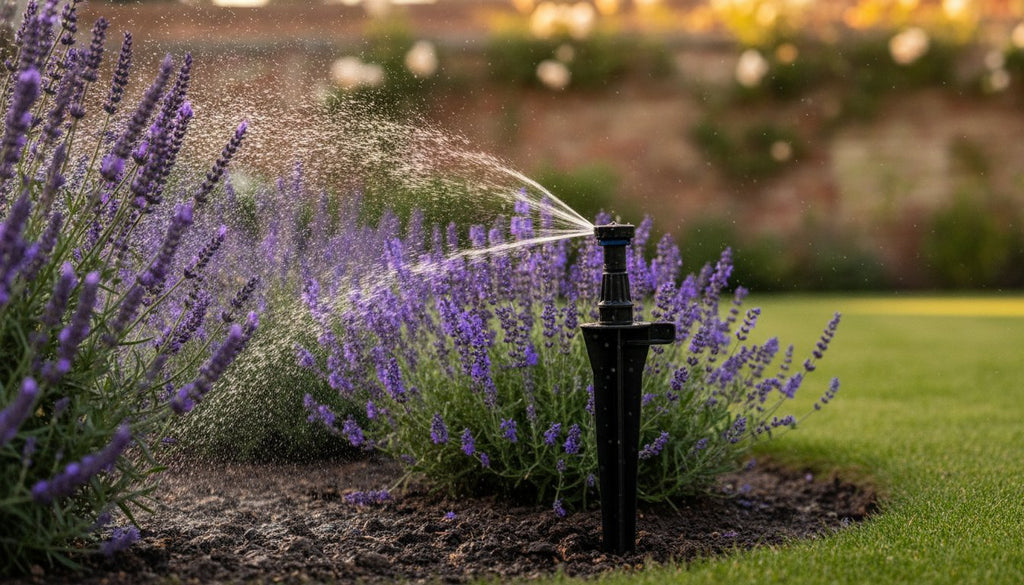
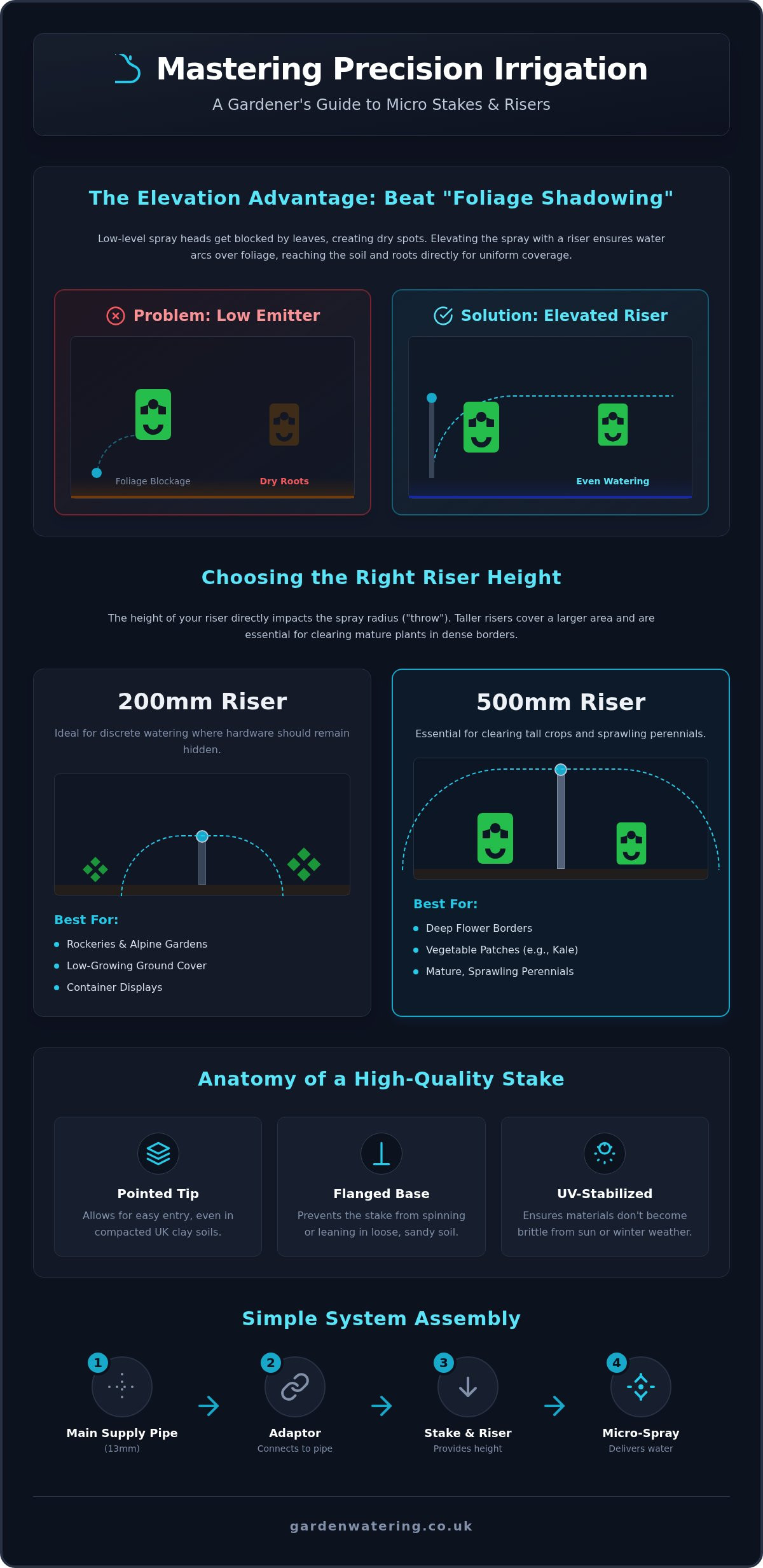
Elevation is critical because of a phenomenon called "shadowing." When a spray head sits too low, the leaves of one plant can physically block water from reaching its neighbor. By using a riser, you lift the spray head above the foliage, allowing the water to arc over the leaves and settle directly into the soil. This prevents dry spots and ensures that even the most crowded flower borders receive uniform hydration without the foliage acting as an unintended umbrella.
It's helpful to distinguish between a hold-down stake and a riser stake. A hold-down stake is primarily for pipe management, keeping 13mm or 4mm supply lines pinned securely to the ground. In contrast, a riser stake is designed to support a vertical pipe that holds a spray jet or micro-nozzle. A rigid riser effectively transforms a ground-level dripper into a mini-sprinkler by elevating the emission point to create a wider, more uniform wetting pattern.
When to Upgrade from Standard Drip Emitters
Standard drip emitters are excellent for establishing young plants or maintaining individual containers. However, as your garden matures and flower borders become denser, ground-level emitters often struggle. You should consider upgrading to a stake and riser system when you notice dry patches behind tall perennials or when your plants grow high enough to shield the soil from low-level sprays. This transition ensures your drip irrigation systems remain effective even as your landscape changes and grows.
The Anatomy of a High-Quality Stake
A reliable stake needs to do more than just stand upright. High-quality designs, such as Asta stakes, feature integrated side-clips that hold 4mm micro-tubing securely without the risk of kinking or slipping. When choosing your components, look for these specific features:
- Pointed Tips: These allow for easy soil entry even in compacted UK clay.
- Flanged Bases: These prevent the stake from "spinning" or leaning in loose, sandy soil.
- UV-Stabilized Materials: Polycarbonate or reinforced plastics ensure the stake won't become brittle after a season in the sun or a harsh winter.
Choosing the Right Height: 200mm vs. 500mm Risers
Selecting the right height for your irrigation micro stakes & risers involves more than just clearing the nearest leaf. It's a calculation of physics and plant growth. The elevation of your spray head directly dictates the "throw" or the radius of the water arc. When you lift a micro-jet higher, you provide the water with more time to travel before gravity pulls it to the soil. This increased trajectory allows a single jet to cover a much larger surface area than it could at ground level.
While many generalist suppliers suggest that a 300mm riser is a universal standard, mature UK gardens often require more variety. A 200mm riser is excellent for discrete watering in rockeries or alpine gardens where you want the hardware to remain hidden. However, for deep flower borders or vegetable patches, a 500mm riser is often essential. This extra height ensures that water clears tall crops like kale or sprawling perennials, preventing the "shadowing" effect mentioned earlier. You can explore our full range of drip irrigation systems to find the base components that support these different elevations.
Calculating Spray Coverage Based on Elevation
Height is the primary lever for controlling your system's footprint. If you double the height of a micro-spray, you don't just clear taller plants; you significantly expand the wetting pattern. In a dense border, this means you can often use fewer spray heads to achieve the same total coverage, which simplifies your pipework. When planning your layout, consider the maximum height your plants will reach in mid-summer. It's always better to have a riser that's slightly too tall than one that becomes buried under foliage by July.
Rigid Risers for Uniform Border Watering
Rigid risers provide the structural integrity needed for consistent, uniform watering. Unlike flexible tubing, a rigid riser won't sag or move over time, ensuring your spray pattern remains exactly where you set it. This stability is vital when you're managing various types of microirrigation systems across different garden zones. For potted plants or irregular containers, you might prefer flexible micro-tube stakes, which allow you to bend and target the water precisely at the root ball. For a clean and professional look in your main beds, rigid components are the superior choice. If you're looking to upgrade your current setup, browsing our specialist watering components can help you find the perfect match for your garden's specific needs.
Stability and Soil Type: Selecting the Best Stake Design
Choosing the right irrigation micro stakes & risers depends heavily on what's beneath your boots. UK gardens present a unique challenge, often swinging between heavy, compacted clay and loose, nutrient-rich compost. If you use a generic, thin stake in soft earth, the weight of the water and the pressure of the spray will cause it to lean or "spin," ruining your carefully planned coverage. Conversely, trying to force a flanged stake into baked summer clay can lead to snapped plastic if the material isn't high-quality. We've seen many systems fail simply because the hardware couldn't handle the physical demands of the soil.
Durability in the British climate is another factor you shouldn't overlook. We recommend components made from UV-stabilised polycarbonate or reinforced plastics. These materials ensure your stakes don't become brittle under the summer sun or crack during a sharp January frost. A well-designed stake should also feature a wide, flat top; this simple engineering choice prevents the micro-tube from kinking at a sharp angle, which would otherwise restrict water flow and strain your tap connection. It's these small details that separate a professional-grade setup from a temporary fix.
The Asta Stake Advantage for 4mm Systems
For those using 4mm micro-tubing, the Asta stake is often the superior choice due to its integrated side-clip. Standard stakes often require you to thread the pipe through a small hole, which is fiddly and prone to slipping over time. The side-clip design allows you to snap the tubing into place securely, ensuring it stays put even if the pipe expands or contracts with temperature changes. This level of security is a vital addition for many who already own Hozelock watering kits and want to expand their system's reach with confidence.
Securing 13mm Supply Pipes in Soft Earth
While micro-components get the most attention, the stability of your 13mm supply pipe is just as important. In soft soil or freshly mulched borders, the main line can shift as water pulses through it. We suggest using flanged hold-down stakes for these sections. The "wings" or flanges on these stakes provide extra surface area, anchoring the pipe firmly in loose earth and preventing it from pulling your micro-jets out of position. If you're working with heavy clay, a simple pointed stake is usually enough to bite into the ground and stay there. Specialists often recommend spacing these stakes every metre to provide the solid foundation needed for a long-lasting drip irrigation system.
Integration and Assembly: Connecting to Your Main System
Once you've selected your irrigation micro stakes & risers, the next step is ensuring a leak-free connection to your water source. Assembly doesn't have to be daunting. Most modern systems rely on a 13mm main supply pipe that acts as the spine of your garden irrigation. To branch off to individual plants, you'll need to create precise entry points for your micro-tubing. We recommend using a dedicated hole punch tool rather than a knife or nail. This creates a clean, circular opening that allows the micro-adaptor to seal perfectly against the pipe wall, preventing pressure loss and ensuring the system maintains the proficiency required for professional results.
Connecting to 13mm Main Supply Pipes
Start by laying out your 13mm pipe along the base of your plants. Identify where each stake will sit. Push the hole punch firmly into the pipe until you hear a click. Next, insert a micro-adaptor into the hole. These small, barbed fittings provide a secure anchor for your 4mm tubing. It's vital to ensure your components are compatible with established standards, such as Hozelock connectors, to avoid frustrating leaks. If you're struggling to push the tubing onto the barb, dipping the end of the pipe in warm water for a few seconds will soften the plastic and make the job much easier.
Securing Micro-Jets and Misters
Asta stakes offer a unique advantage during assembly because of their adaptable head design. You can often clip micro-sprays or misters directly onto the stake head or use a threaded adaptor to mount a rigid riser. When using threaded components, hand-tight is usually sufficient. A common mistake is over-tightening these threads; this can strip the plastic or crush the internal washer. Additionally, always verify your tube diameters before you begin. While 4mm is the UK standard, some international kits use 5mm tubing which won't fit standard micro-adaptors. Using Asta Stake Adaptors allows for a modular approach, letting you swap a 180-degree fan spray for a 360-degree jet in seconds without re-cutting your pipes. For a seamless setup, browse our professional irrigation fitting adaptors to ensure every part of your system locks together perfectly.
Top Recommendations for UK Gardens in 2026
Choosing the right irrigation micro stakes & risers often comes down to the specific layout of your growing space. After 15 years of helping UK gardeners refine their systems, we've identified the combinations that deliver the best performance in our unique climate. Whether you're managing a compact patio or a sprawling allotment, the right hardware ensures your Hozelock watering kits perform at their peak. These components are the essential bridge between your main supply and the plants that need it most.
Standout Products for Allotment Owners
For vegetable patches and allotments, we recommend the 310mm Asta Stakes paired with rigid risers. This setup provides the height needed for overhead watering, ensuring that crops like lettuce or brassicas receive a gentle, rain-like spray. An expert tip for allotment owners is to use cross-shaped nozzles. These are designed for exceptionally even water distribution, which is vital when you're trying to maximise yield in a limited space. The pointed design of these stakes makes them particularly easy to relocate as your crop rotation changes throughout the season.
If you're managing large flower borders, Ultra Stakes are the most efficient choice for rapid installation. These often come with pre-fitted 500mm micro-tubing, allowing you to connect multiple spray heads to your main line in a fraction of the time it takes to cut and fit individual tubes. The added height of the pre-fitted tube is perfect for reaching over established shrubs and ensuring the water isn't blocked by dense outer leaves.
Low-Profile Solutions for Landscaped Beds
For potted plants and container displays, precision is more important than broad coverage. We suggest using micro tube stakes with 500mm flexible tubing. This allows for precise pot-to-pot delivery, letting you snake the pipe around the base of your containers for a clean, professional look. Because the tubing is flexible, you can target the water exactly at the root ball of each individual plant without wasting water on the surrounding patio or gravel. This targeted approach is especially helpful when managing drip irrigation systems during periods of water scarcity.
For those who have already invested in a technical setup, these stakes act as the missing link that provides the stability standard kits sometimes lack in soft compost. By selecting durable, polycarbonate components, you ensure your system remains reliable through summer heatwaves and winter frosts alike. To get started with your upgrade, you can shop the full Irrigation Micro Stakes & Risers collection here to find the perfect match for your garden's needs.
Elevate Your Garden’s Watering Efficiency
Achieving a professional irrigation setup depends on the structural details that often go overlooked. By selecting the right irrigation micro stakes & risers, you ensure that every drop of water clears the foliage and reaches the root zone without waste. Remember that height is your primary tool for coverage; use 500mm risers for dense borders and flanged stakes to maintain stability in softer UK soils. These small adjustments transform a basic system into a precise, water-efficient solution that supports long-term plant health.
Our team brings 15 years of specialist Hozelock expertise to every recommendation, ensuring you receive the best advice for your specific landscape. We focus on durable, UV-stabilised components that won't fail during harsh winters or summer heatwaves. Take the next step in perfecting your garden today. Browse the Irrigation Micro Stakes & Risers Collection and enjoy free UK delivery on qualifying orders. We're here to help you cultivate a thriving, resilient landscape with confidence.
Frequently Asked Questions
What is the difference between a micro stake and a rigid riser?
A micro stake is the ground-anchoring component, while a rigid riser is the vertical pipe that elevates the spray head. You use the stake to provide stability and the riser to achieve the necessary height for clearing foliage. In most irrigation micro stakes & risers setups, these two parts work together. The stake holds the riser firmly in place, ensuring your micro-jets stay at the correct angle even during high-pressure watering cycles.
Can I use these stakes with my existing Hozelock automatic watering system?
Yes, these components are fully compatible with standard Hozelock systems. We often recommend them as the ideal upgrade for those who already own Hozelock kits but need better stability or height in their borders. Since most Hozelock systems use 13mm main lines and 4mm micro-tubing, our stakes and risers integrate seamlessly. This allows you to customise your system's reach without needing to replace your existing timers or connectors.
How deep should I push the stakes into the ground for maximum stability?
You should push the stake into the soil until the base or flange feels completely firm, which usually requires burying at least 100mm to 150mm of the spike. If you're using taller 500mm risers, deeper insertion is vital to prevent the assembly from leaning. In soft or freshly mulched earth, ensure the soil is compacted slightly around the entry point. This provides the lateral support needed to keep your spray patterns consistent.
Do I need a specific tool to connect the risers to my irrigation pipe?
A dedicated hole punch tool is the only specialist item you'll need for a professional installation. This tool creates the perfect 4mm opening in your 13mm supply pipe for the micro-adaptors. Once the hole is punched, you can typically assemble the risers and stakes by hand. Most risers use a simple push-fit or threaded connection that doesn't require wrenches, making it easy to adjust your layout as your garden grows.
Will these stakes work in heavy clay soil common in the UK?
Our stakes are designed with pointed tips specifically to penetrate tough UK clay. If the ground is exceptionally dry and baked hard during the summer, it's helpful to water the area briefly before installation to soften the soil. This prevents the plastic from stressing as you push it in. Once the clay dries around the stake, it actually provides an incredibly stable anchor that is less likely to shift than in sandy soils.
How many micro stakes can I run off a single 13mm supply line?
A standard 13mm supply line can typically support between 15 and 30 micro-emitters, depending on your household water pressure and the flow rate of the jets. If you're using high-flow 360-degree sprays, you'll be at the lower end of that range. We recommend testing the flow at the furthest stake from the tap. If the spray radius looks weak, you may need to split your system into two separate zones.
Are the risers adjustable in height once they are installed?
Standard rigid risers aren't telescopic, so they have a fixed height once cut or purchased. However, because the system is modular, you can easily swap a 200mm riser for a 500mm version if your plants grow taller than expected. This flexibility is a key benefit of using a professional setup. If you anticipate significant growth, it's often better to start with a taller riser and push the stake deeper into the ground initially.
`-
Posted in
drip irrigation, drought tolerant gardening, garden maintenance, gardening, irrigation, irrigation micro stakes & risers, micro irrigation, UK gardening, watering systems