Hozelock Connectors Explained: Which Fitting Goes Where
Almost every hose set-up in the UK runs on Hozelock's click system, or on fittings made to fit it. Once you know which part goes where, it's simple. This guide covers what fits your tap, what goes on each end of the hose, how to join or split hoses, and how to fix the leaks and blow-offs we get asked about most.
The short answer: most gardens need three parts. A tap connector screws onto the tap. A hose end connector goes on each end of the hose. If you want to swap spray guns and sprinklers without going back to the tap, use an AquaStop connector on the accessory end instead of a standard one.
How the click system works
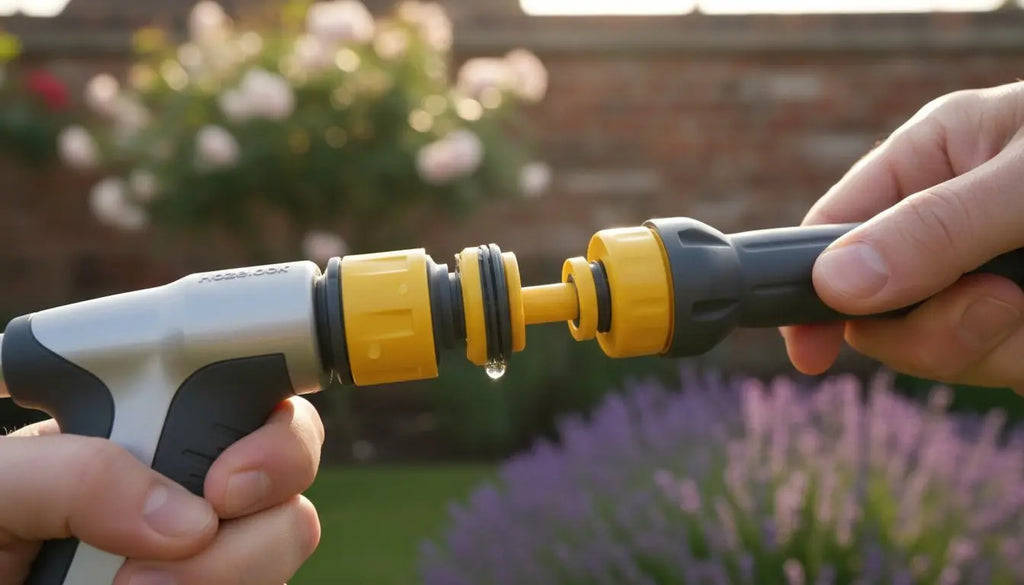
Every part is either male or female. Tap connectors, accessory inlets (spray guns, sprinklers, timers) and joiners have a male spigot. Hose end connectors are female: they grip the hose and click onto any male spigot. Because the spigot size is the same across the whole range, standard, Plus and Pro parts all fit together.
The click means the connector's locking sleeve has gripped the spigot. Unless you hear it, the connection isn't secure.
Step 1: Match the connector to your tap
Threaded outside taps
Most UK outside taps have a 3/4" BSP thread. BSP sizes are nominal, so a ruler across the outside of the thread gives you a different number:
| Measured across the thread | BSP size | Where you'll find it |
|---|---|---|
| About 21mm | 1/2" | Older and smaller taps |
| About 26.5mm | 3/4" | Most UK outside taps |
| About 33mm | 1" | Larger or commercial taps |
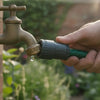
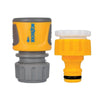
- Hozelock 2175 Threaded Tap Connector: the standard choice. It fits 3/4" taps and comes with a 1/2" adapter.
- Hozelock Pro 2041 Tap Connector: nickel-plated brass, for a tap connector that stays on all year. It won't crack in a frost like plastic can.
Taps with no thread
- 2176 Round Tap Connector: for plain round or oval spouts between 14mm and 18mm across.
- 2177 Mixer Tap Connector: for kitchen mixers and other unthreaded spouts.
- 2274 Multi Tap Adapter: for larger unthreaded spouts up to 34mm wide. It comes with several sealing washers.
Kitchen or bathroom taps with an aerator
If you don't have an outside tap, the 2304 Indoor Tap Connector replaces the aerator on modern taps with a 22mm female head. It gives you a 3/4" thread for a tap connector or timer. For more detail on tap fittings, see our Hozelock tap connector guide.
Step 2: Choose your hose end connectors
Standard Hozelock hose end connectors fit 12.5mm (1/2") and 15mm (5/8") hose. Those are the two usual garden hose sizes. A 19mm (3/4") hose needs a connector made for 19mm, so check the pack before you buy.
| Connector | What it does | Best for |
|---|---|---|
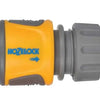
| 2166 Hose End Connector | The basic click connector | The tap end of the hose |
| 2070 Soft Touch (also as a twin pack) | Same job, with rubber grip pads | Wet or cold hands |
| 2050 Hose End Connector Plus | Soft-touch grip and a flexible tail that stops the hose kinking at the joint | Hoses that get dragged around corners |
| 2075, 2185 or 2055 Plus AquaStop | Shuts off the water when you unclip an accessory | The spray gun or sprinkler end |
| Pro 2030 and Pro 2035 AquaStop | Zinc die-cast sleeve, firmer grip, longer life | Heavy daily use, or connectors left out all year |
Which end gets AquaStop? Only the accessory end. The valve stops water coming out of the hose when you unclip a spray gun or sprinkler, so you can swap tools without getting wet. At the tap end it does nothing useful, so use a standard connector there.
Step 3: Joining, repairing and splitting hoses
- Repairing a split hose: cut out the damaged section and join the two cut ends with a 2100 Hose Repair Connector. The metal version is the Pro 2043.
- Joining two hoses that already have connectors on: use a double male joiner, either the 2291 or the brass Pro 2044. Click a connector onto each side.
- Running two lines from one hose: the 2293 Y Connector splits one hose into two. It has no shut-offs.
- Running several lines from one tap, each with its own control: choose the 2256 Dual, the 2252 2-Way (quarter-turn valves, fits 1/2", 3/4" and 1" taps), the 2250 Flowmax 3-Way or the 2150 4-Way. These are the usual way to run a watering timer and a hose from the same tap.
- Connecting a threaded accessory: the 2289 Accessory Adaptor screws into any 3/4" female thread and gives you a click connection.
Standard, Plus or Pro: is the upgrade worth it?
All three ranges seal equally well when they're in good condition. The difference is grip and how long they last.
- Standard is fine for a hose you use now and then, such as filling a watering can or washing the car.
- Plus is easier to work with wet hands, and the longer tail stops the hose kinking at the connector. It's worth it if you water every day in summer.
- Pro is metal, so it survives being trodden on, run over by a wheelbarrow or left out through the winter. Use it on anything that stays connected all year, such as a tap connector feeding a timer. Our plastic vs brass fittings guide goes into this in more detail.
Kits: the easy way to fit a new hose
- 2385 Hose Connector Kit: a tap connector, a hose end connector and an AquaStop connector. Everything for one hose.
- 2352 Complete Kit with Nozzle: the same idea, with an adjustable nozzle included.
- 2071 Tap Connector and Hose End Connector Set: just the tap end.
Fixing leaks, blow-offs and stiff connectors
Dripping where the click connector meets the tap connector
This is almost always a worn or dry O-ring on the male spigot. Pull the old one off with a fingernail and fit a new one from an O-ring kit. It takes a minute and needs no tools.
Dripping at the tap thread
Unscrew the tap connector and check the rubber washer inside it. If the washer is missing, split or squashed out of shape, replace it. Screw the connector back on hand-tight. Overtightening distorts the washer and makes the leak worse. If you're using the 1/2" adapter, check that it's screwed fully home too.
The hose pops off when the water's turned on
- Cut the end of the hose square with a sharp knife. A ragged or angled end won't seal or grip properly.
- Push the hose fully onto the connector's tail before you screw the collar down.
- Check the hose size. A 12.5mm or 15mm connector won't hold a 19mm hose, and a worn, softened hose end won't grip either. Cut 2–3cm off and refit.
- Timers and shut-off valves send a pressure spike back down the hose when they close. A Pro connector or a Plus connector with its longer tail holds better in that situation.
Stiff connectors that won't click
Grit and limescale build up in the sleeve. Rinse the connector, work the sleeve back and forth a few times, and soak it in white vinegar if you're in a hard-water area.
Winter
Water left inside a plastic connector can freeze and crack it. Before the first frost, drain the hose and bring the plastic fittings indoors. Pro metal connectors cope much better if they have to stay outside.
Frequently asked questions
Do Hozelock connectors fit other brands' hoses and fittings?
They fit any 12.5mm or 15mm garden hose, whatever the brand. Most fittings sold as "Hozelock-compatible" click together with genuine Hozelock parts. Gardena's own click system is a different design, so don't expect the two to mix.
Do I need an AquaStop connector at both ends of the hose?
No. Fit it only on the end where you attach spray guns and sprinklers. Use a standard connector at the tap end.
Can I connect a hose to my kitchen tap?
Yes. Use the 2304 Indoor Tap Connector if your tap has a screw-in aerator. Use the 2177 or 2274 if the spout is plain with no thread.
Is metal better than plastic?
Metal lasts longer and copes with frost and knocks. Plastic works just as well for occasional use and costs less. Many people use metal at the tap, where the fitting stays all year, and plastic everywhere else.
How often should I replace the O-rings?
Replace them when a joint starts to drip. For a hose used every day, that's usually once every season or two. Keep a spare O-ring kit in the shed.
Not sure which fittings you need? Browse our full range of Hozelock connectors, or get in touch and tell us what tap and hose you have. We'll tell you exactly what you need.
-
Posted in
hozelock connector