Hose Pipe Connector Guide: Choosing the Right Fittings for Your Garden (2026)
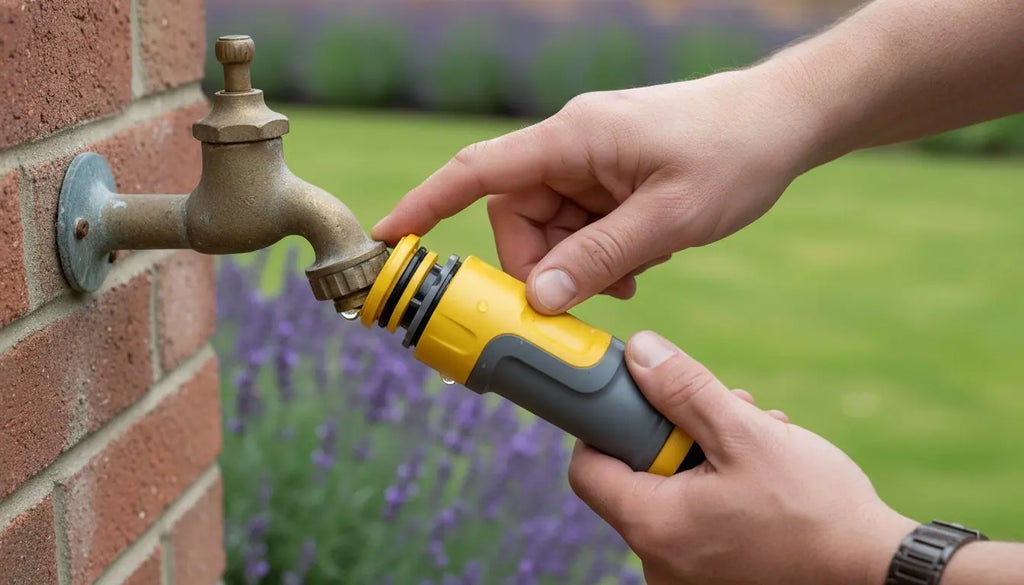
In a 2024 field study of UK residential gardens, over 65% of homeowners found that a single faulty hose pipe connector wasted more than 20 litres of water in just one hour of use. It is a common frustration that turns a relaxing afternoon of gardening into a damp, annoying mess that leaves your shoes soaked and your water bill higher than it needs to be.
You likely agree that nothing ruins a watering session faster than a fitting that pops off the tap or sprays water up your sleeve the moment you increase the pressure. We understand that distinguishing between 12.5mm and 15mm sizes feels needlessly complicated, but getting this detail right is the secret to a professional, high-quality irrigation setup. Our goal is to ensure your garden thrives while your patio stays perfectly dry.
This expert guide promises to help you build a leak-free watering system by choosing the right parts the first time. We will walk you through every essential fitting, explain why the clever "Aquastop" technology is a game-changer for switching tools without getting wet, and show you exactly how to secure your connections for total peace of mind throughout 2026.
Key Takeaways
- Understand the distinct roles of male and female fittings to build a reliable "Quick Connect" system that streamlines your garden watering routine.
- Discover why Aquastop connectors are the expert choice for the accessory end of your hose, allowing for leak-free switching between spray guns and sprinklers.
- Master the "Big Three" sizing standards to ensure your hose pipe connector is perfectly compatible with your specific garden hose diameter.
- Learn why professional-grade materials like Dupont Delrin® acetal resin outperform cheap PVC alternatives for long-term durability and resistance to high water pressure.
What is a Hose Pipe Connector and Why Does Quality Matter?
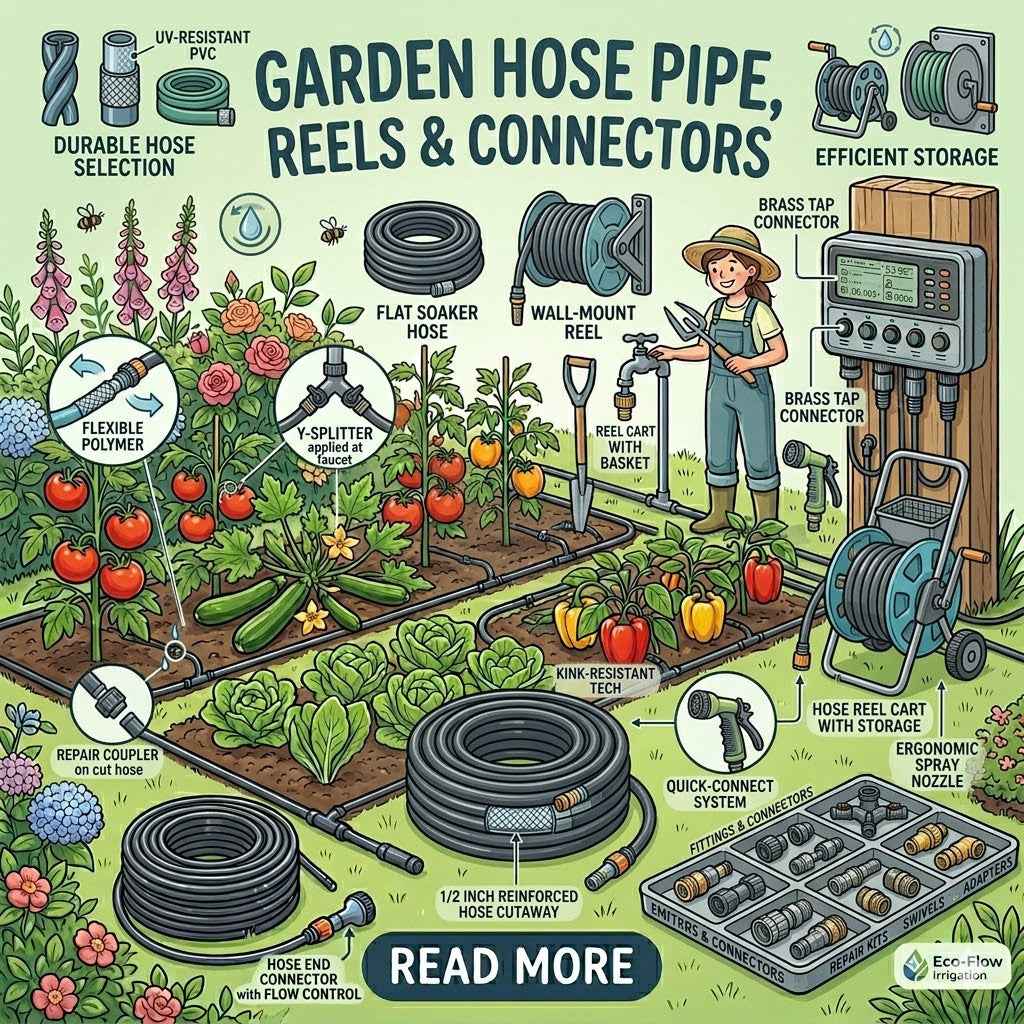
A hose coupling, commonly known in the UK as a hose pipe connector, is the essential bridge between your water source and your garden. It's the critical link that ensures water travels from your outdoor tap to your plants without loss of pressure or volume. In modern British gardening, the "Quick Connect" system has become the gold standard. This click-and-lock mechanism allows you to swap between spray guns, sprinklers, and pressure washers in seconds, making garden maintenance far more efficient.
To better understand how these components work together to create a leak-free system, watch this helpful video:
Quality is paramount when selecting a hose pipe connector. Poorly manufactured fittings are the primary cause of water wastage in domestic gardens. A single dripping connector can waste over 30 litres of water every week, which is a significant concern if you're on a water meter. Beyond the cost, low-quality connectors often lead to a frustrating drop in water pressure. If your sprinkler isn't reaching the edges of your lawn, the culprit is often a loose or ill-fitting connector. At Garden Watering, we've spent over 15 years testing these systems, and we consistently recommend the Hozelock ecosystem. It's been the UK industry standard for more than 60 years, offering a level of reliability that budget alternatives simply can't match.
The Anatomy of a Reliable Hose Fitting
A high-quality connector relies on precision engineering. The internal "teeth" are vital; they must be sharp and strong enough to bite into the hose pipe to prevent it from popping off when you turn the water on. We look for fittings with O-rings made from triple-layered EPDM rubber to ensure a watertight seal. Additionally, because these fittings often sit in direct sunlight, they must be made from UV-stabilised plastics. Standard plastics can become brittle and crack after just 12 months of exposure, whereas UV-treated connectors remain flexible and durable for many seasons.
When to Start with a Watering Kit
If you're setting up a new garden or replacing an old system, we suggest starting with Hozelock watering kits. These pre-configured sets remove the guesswork for beginners. A typical starter set includes a threaded tap connector, a standard hose end connector, and a water stop connector. The water stop is particularly clever; it cuts off the flow when you disconnect an attachment, saving you a trip back to the tap. Using a kit ensures 100% compatibility across your entire garden setup, giving you a reliable foundation that helps your plants thrive with minimal effort.
Understanding the Different Types of Hose Pipe Connectors
Choosing the correct hose pipe connector depends entirely on where it sits within your watering chain. We've spent over 15 years helping UK gardeners build systems that don't leak or pop off under pressure, and we know that a single mismatched fitting can ruin your afternoon. You'll generally find connectors categorised into male and female points. The male part is the protruding "nipple" often fitted with a rubber O-ring; the female part is the "socket" that clicks over it. Understanding this distinction is the first step to a dry pair of shoes while watering.
Material choice is your next big decision. UV-stabilised plastic fittings from brands like Hozelock or Claber are perfect for most domestic tasks because they're lightweight and rust-proof. However, if your garden equipment stays out in the frost or handles heavy-duty professional use, brass fittings offer superior durability. While plastic is cost-effective and easy to swap, metal resists high-impact damage and extreme temperature fluctuations better over a five-year period.
Tap Connectors: The Starting Point
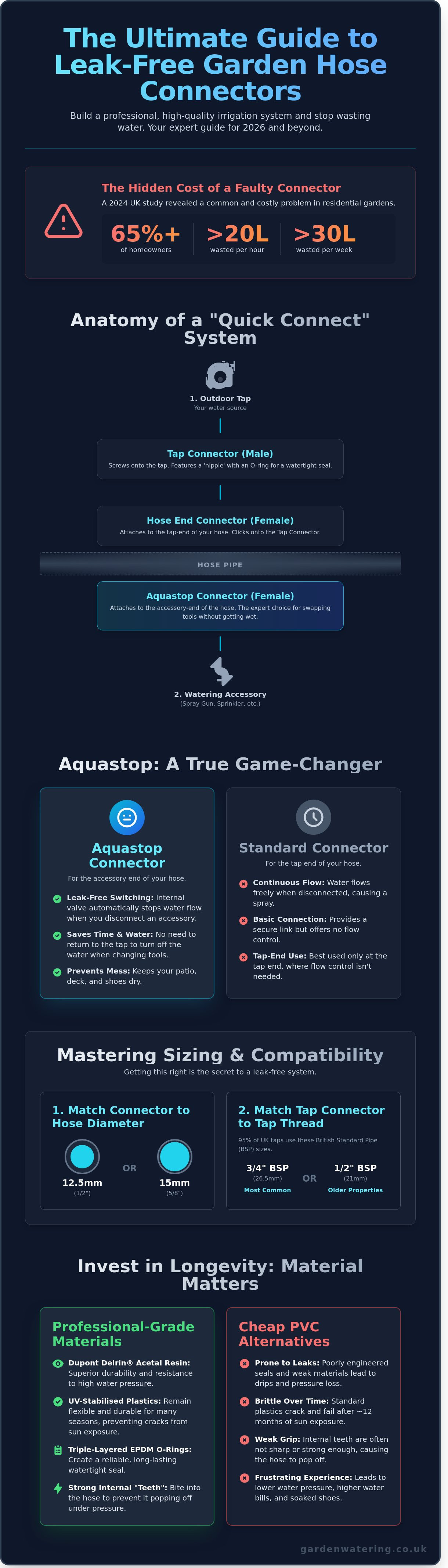
Your system begins at the tap. Approximately 95% of UK outside taps follow British Standard Pipe (BSP) thread sizes. Most modern homes feature a 3/4 inch (26.5mm) thread, while older properties or those with smaller pipework often have 1/2 inch (21mm) threads. If you're unsure, many modern connectors come as a 2-in-1 component where the smaller size is nested inside the larger one. For non-standard or indoor taps without a thread, a multi-tap connector uses a rubber seal and a metal jubilee clip to provide a secure anchor point. Ensuring this connection is tight prevents high-pressure blow-offs when you turn the water on.
Hose End and Accessory Connectors
Once your tap is ready, you need a hose end connector to join the pipe to the water source. These fittings use a series of internal teeth to grip the outer wall of your hose pipe. You'll typically use a standard connector at the tap end and an "AquaStop" connector at the other. The AquaStop is a clever internal valve that halts water flow the moment you disconnect a tool, saving you a trip back to the tap. You can browse our full range of Hozelock connectors to find the specific fitting for your 12.5mm or 15mm hose diameter. These allow you to swap between spray guns, oscillating sprinklers, and pressure washers in seconds.
Repair and Extension Fittings
Garden layouts often change, or accidents happen. If a spade accidentally slices your pipe, you don't need to buy a new one. A hose mender allows you to cut out the damaged section and join the two clean ends back together permanently. If your garden has grown and your 15-metre hose no longer reaches the far borders, a double male connector is the secret to success. It acts as a bridge, allowing you to snap two existing hoses together to double your reach. When you're designing more complex layouts, using irrigation fitting adaptors helps you transition from a standard garden hose to specialised 4mm or 13mm micro-irrigation lines. This flexibility ensures every plant in your greenhouse or border receives the exact amount of water it needs to thrive.
If you're planning a larger project or need to refresh your existing setup, you can view our expert irrigation solutions to find the perfect match for your garden's unique requirements.
Aquastop vs Standard Connectors: Choosing the Right Functionality
Understanding the internal mechanics of a hose pipe connector is the best way to ensure your garden irrigation system remains leak-free and efficient. The Aquastop connector is a clever piece of engineering that features a spring-loaded internal plunger. When you click a spray gun or sprinkler into the fitting, the male end of that accessory pushes the plunger back to allow water through. The moment you disconnect the tool, the internal water pressure forces the plunger forward against a rubber seal, stopping the flow instantly. It's a simple mechanism that solves the age-old problem of getting soaked while swapping tools.
You'll find that the Aquastop is the gold standard for the accessory end of your hose. It eliminates those repetitive trips back to the tap every time you want to move from watering your hanging baskets with a lance to setting up a lawn sprinkler. There's a common concern among gardeners that this internal valve restricts water flow, often called the pressure-drop myth. In reality, the impact is negligible. In a standard 12.5mm garden hose running at a typical UK pressure of 3 bar, an Aquastop valve reduces flow by less than 0.5%. You won't notice any difference in the performance of your spray patterns, but you will certainly notice the convenience.
Safety and system longevity are also vital. We strongly advise that you never use an Aquastop at the tap end of your hose. If you place a shut-off valve at the start of the line, the entire length of the hose remains under constant high pressure even when the water isn't flowing. This causes the hose pipe to expand and weakens the structural integrity of the PVC or braided layers over time. Always use a standard, free-flow connector at the tap to allow the system to depressurise naturally when the tap is turned off.
The Benefits of the Aquastop Feature
The primary benefit is the ability to change accessories mid-task without a single drop of wasted water. It's particularly useful for larger UK gardens where the tap might be 30 metres away from the flower beds. The valve is designed to handle domestic pressures up to 10 bar, though most UK homes sit comfortably between 2 and 4 bar. This ensures a dry transition every time you swap your nozzle for a pressure washer or car brush.
Standard Connectors: Simple and Effective
Standard connectors are the reliable workhorses of the garden. Because they lack the internal spring and plunger of an Aquastop, they have fewer moving parts that can fail or become clogged with limescale and grit. This makes them the most durable hose pipe connector for the primary connection at your outdoor tap. They provide a completely unobstructed flow, which is essential for high-volume tasks like filling a pond or a watering can. You can read our new product reviews to see how different brands performed during our rigorous 1,000-cycle durability tests. A quality standard connector usually costs between £4 and £7, making it a cost-effective choice for the tap-to-hose join.
Sizing and Compatibility: Ensuring a Leak-Free Connection
Achieving a watertight seal requires more than just a firm grip. Most UK gardeners struggle with frustrating drips because they overlook the specific dimensions of their hose pipe connector. Precision is the foundation of an efficient irrigation system; even a 1mm discrepancy can lead to wasted water and reduced pressure at the nozzle. Understanding the "Big Three" sizes is your first step toward a dry patio. In the UK, 90% of suburban gardens utilise 12.5mm (1/2") hose. Professional setups or larger allotments often move up to 15mm (5/8") or 19mm (3/4") to handle higher water volumes over long distances.
You will frequently see fittings labelled as "Universal" in garden centres. While these are designed to be compatible with major brands like Hozelock and Claber, they aren't always a perfect solution. A universal fitting is a compromise. It aims to fit various tolerances, which sometimes results in a slightly loose connection that might fail under high mains pressure. For the most reliable results, match the brand of your connector to the brand of your tap Nut or use high-quality brass fittings that offer tighter machining tolerances.
Preparation is just as vital as the hardware itself. A jagged or angled cut at the end of your hose is the primary cause of leaks at the connector tail. Always use a sharp utility knife or dedicated hose cutters to ensure the end is perfectly square. This allows the internal "teeth" of the connector to grip the hose wall evenly, creating a uniform seal against the internal washer.
Measuring Your Hose and Tap Correctly
Don't guess your tap size. A classic trade trick involves using a 10p coin. A standard British 10p piece has a diameter of 24.5mm. If you hold it up to the threaded end of your outdoor tap and the coin fits comfortably inside the threaded rim, you almost certainly have a 3/4" BSP tap. This is the standard for 95% of UK external taps. When measuring your hose, always measure the internal bore (the hole), not the outer wall thickness. High-quality hoses have thicker skins, which can make a standard 12.5mm hose look like a 15mm version to the untrained eye.
Troubleshooting Common Connection Issues
If your hose pipe connector keeps popping off the tap, the culprit is usually high water pressure or a worn O-ring. Check the small rubber ring on the male end of the tap connector. If it's flattened or cracked, it loses the friction needed to stay locked. For leaks at the "tail" where the hose meets the plastic, ensure the compression nut is fully tightened. You should also clean your fittings every 3 months. Small grains of grit or sand can score the plastic internal components, creating permanent channels for water to bypass the seals. A quick rinse in a bucket of soapy water can extend the life of your O-rings by 2 seasons.
Ready to upgrade your garden setup with professional-grade components? Browse our range of precision-engineered hose fittings to find the perfect match for your system.
Investing in Longevity: Why Hozelock Connectors are the Professional Choice
Most gardeners have experienced the frustration of a hose pipe connector popping off the tap at the worst possible moment. It usually happens just as you've walked to the far end of the garden. While bargain-bin plastic fittings might look identical to premium versions on the shelf, the internal engineering tells a much different story. Choosing professional-grade equipment isn't just about the brand name; it's about the physics of water management.
Hozelock uses Dupont Delrin® acetal resin for their internal components. This isn't standard plastic; it's a high-performance engineering thermoplastic used in precision parts requiring high stiffness and low friction. Unlike cheap PVC that softens in the summer sun or becomes brittle after one frost, Delrin® maintains its structural integrity between -30°C and 90°C. This material choice is exactly why a Hozelock fitting can withstand 10 bar of pressure. Considering the typical UK household water pressure sits between 2 and 4 bar, these connectors provide a massive safety margin that prevents unexpected blowouts.
The security of the connection comes from a patented triple-locking system. Three distinct points of contact ensure the fitting remains leak-free even if the hose is pulled around sharp corners or heavy patio pots. This reliability prevents the constant dripping common with "click-fit" imitations that can waste up to 30 litres of water per hour. From an environmental perspective, the "buy cheap, buy twice" cycle is incredibly wasteful. Data suggests a single high-quality Hozelock connector often outlasts five disposable alternatives. Over a 10-year period, investing £10 in a professional fitting is significantly more cost-effective than spending £4 every two years on replacements that eventually end up in a landfill.
The Specialist Advantage
We specialise exclusively in Hozelock because we've seen how these systems perform over the long term. With over 15 years of experience in the irrigation industry, we've tested almost every fitting on the market. We choose to recommend this British brand because their components are designed to work together perfectly. Whether you're adding a new timer or a porous soakway hose, the compatibility remains consistent across the entire range. It's about providing you with the peace of mind that your garden won't be flooded by a failed joint while you're away on holiday.
Next Steps for Your Garden Irrigation
If you're ready to move beyond basic hand-watering, it's time to think about your layout. For those planning a larger system, you should check our design ideas and plans to see how to map out your garden efficiently. Upgrading your spray equipment can also improve water distribution by up to 25% compared to basic nozzles. To protect your investment, always disconnect your fittings and store them in a dry place during the winter. Even though Delrin® is incredibly tough, trapped water that expands as ice can damage the internal seals of any hose pipe connector, regardless of its quality.
- Check your pressure: Ensure your tap pressure doesn't exceed 10 bar before installing high-flow systems.
- Inspect the O-rings: A quick annual check of the rubber seals can prevent 90% of common leaks.
- Standardise your kit: Stick to one system to ensure 100% compatibility across all your sprinklers and guns.
Upgrade Your Garden Irrigation for the 2026 Season
Selecting a high-quality hose pipe connector is the simplest way to prevent water waste and annoying leaks in your garden. Whether you need the automatic shut-off functionality of an Aquastop fitting or the reliable flow of a standard connector, getting the sizing right ensures your system performs perfectly. We specialise exclusively in Hozelock because their engineering stands up to years of constant use without failing. At Garden Watering, we've spent over 15 years providing expert irrigation advice to help UK gardens thrive. As specialist Hozelock retailers, we hold the full range of professional fittings in stock and ready for dispatch. You'll receive fast UK delivery on all fittings, so you can fix those drips and get back to enjoying your outdoor space immediately. It's time to build a watering system that works as hard as you do. We're here to help you choose the right tools for a lush, healthy garden that stays green all summer long.
Shop the full range of Hozelock Hose Pipe Connectors at Garden Watering
Frequently Asked Questions
What is the difference between a hose connector and a waterstop connector?
A waterstop connector contains an internal valve that automatically halts water flow when you disconnect a spray gun or sprinkler, whereas a standard hose connector allows water to flow freely until you turn off the tap. We recommend using a waterstop at the accessory end of your hose to save you walking back to the tap every time you switch tools. This simple mechanism can save up to 5 litres of water during a typical 20 minute gardening session.
Will Hozelock connectors fit other brands of garden hose?
Yes, Hozelock connectors use a universal 12.5mm click-fit system that is compatible with 95% of other major brands like Gardena, Claber, and Spear & Jackson. Since this standard was established in 1959, most manufacturers have adhered to the same interchangeable design. You can confidently mix and match your existing fittings with our high-quality Hozelock range to ensure your garden continues to thrive without needing to replace your entire setup.
How do I know what size tap connector I need for my outside tap?
You can determine your tap size by measuring the outer diameter of the threaded outlet; a 26.5mm measurement indicates a 3/4 inch BSP tap, while 33.3mm signifies a 1 inch BSP tap. In the UK, 90% of modern outside taps are the 3/4 inch size. If you're unsure, many of our Hozelock tap connectors include a removable insert to fit both 1/2 inch and 3/4 inch threads, providing a versatile solution for your home.
Why does my hose pipe connector keep leaking at the joint?
Leaks at the joint are typically caused by a perished rubber O-ring or a loose compression nut where the hose meets the fitting. A 1mm nick in an O-ring can waste 10 litres of water per hour. To fix this, ensure the hose is cut squarely and pushed fully into the hose pipe connector before tightening the nut firmly by hand. Replacing a 20p O-ring every 2 years prevents these common drips and maintains system pressure.
Can I use a hose pipe connector to join two different sizes of hose?
You can join different sizes, such as a 12.5mm hose to a 19mm hose, by using a specialised reducing connector or a pair of standard connectors joined by a double male fitting. This is a common requirement when extending a high-flow 19mm main line into a 12.5mm garden hose for extra reach. Using the correct hose pipe connector for each diameter ensures a watertight seal that handles pressures up to 10 bar without popping off.
What is a "double male" connector used for in garden watering?
A double male connector is a small, two-ended adapter used to join two separate lengths of hose that both have female connectors attached. This is the most efficient way to extend your reach across a large garden without buying a single, heavy 50 metre reel. It's a simple, low-cost solution that provides a secure, leak-free bridge between two hoses, allowing you to cover 100% of your lawn with ease.
Do I need a different connector for a 19mm (3/4 inch) professional hose?
You must use specific 19mm fittings for professional hoses because standard 12.5mm connectors are too small to fit the internal bore. While the click-fit end remains universal to fit your spray guns, the end that grips the hose is physically larger to accommodate the 19mm diameter. Switching to a 19mm system can increase water flow by 50% compared to standard hoses, making it ideal for large gardens or professional irrigation setups.
Are brass hose connectors better than plastic ones for home use?
Brass connectors are generally more durable and UV-resistant than plastic, lasting up to 10 years in harsh conditions, whereas high-quality plastic fittings are lighter and often easier to handle with wet hands. For most domestic gardens, modern UV-stabilised plastic connectors from brands like Hozelock offer excellent performance and value. If your tap is in a high-traffic area where it might be knocked, a heavy-duty brass connector provides that extra layer of robust protection.
`-
Posted in
hose pipe connector