Irrigation Hold Down Stakes, Clips & Saddles: The 2026 Buyer’s Guide

The difference between a professional irrigation installation and a messy DIY project often comes down to the hardware keeping everything in place. It's frustrating to invest in a high-quality watering system only to find your pipes sagging against the garden wall or creating trip hazards on your lawn. To maintain a neat and efficient layout, you need the right irrigation hold down stakes, clips, cleat's,ratchets & saddles to secure every connection. We understand that a garden should be a place of relaxation, not a constant battle with shifting hoses and fittings that pop off under pressure.
This 2026 guide will help you master the art of securing your system to prevent leaks, trips, and long-term pipe damage. You'll learn how to choose between heavy-duty galvanized stakes for tough soil and specialized wall clips for vertical layouts. We'll walk you through the essential tools every specialist recommends to ensure your pipes stay exactly where you installed them. By the end, you'll have the confidence to create a professional-looking irrigation layout that performs reliably through every season.
Key Takeaways
- Eliminate trip hazards and stop "pipe crawl" by identifying the specific securing tools needed for high-traffic garden zones.
- Learn to select the correct irrigation hold down stakes, clips, cleat's,ratchets & saddles to keep your system immovable on any surface.
- Discover the professional advantage of using ratchet clamps over standard fittings to prevent joints from popping off during high-pressure water surges.
- Master the two-step mapping process to accurately measure your pipe diameter and calculate the exact number of fasteners your layout requires.
- Understand which materials perform best in UK conditions, ensuring your system remains secure against frost heave and wind.
Why Irrigation Hold Down Stakes and Clips are Essential
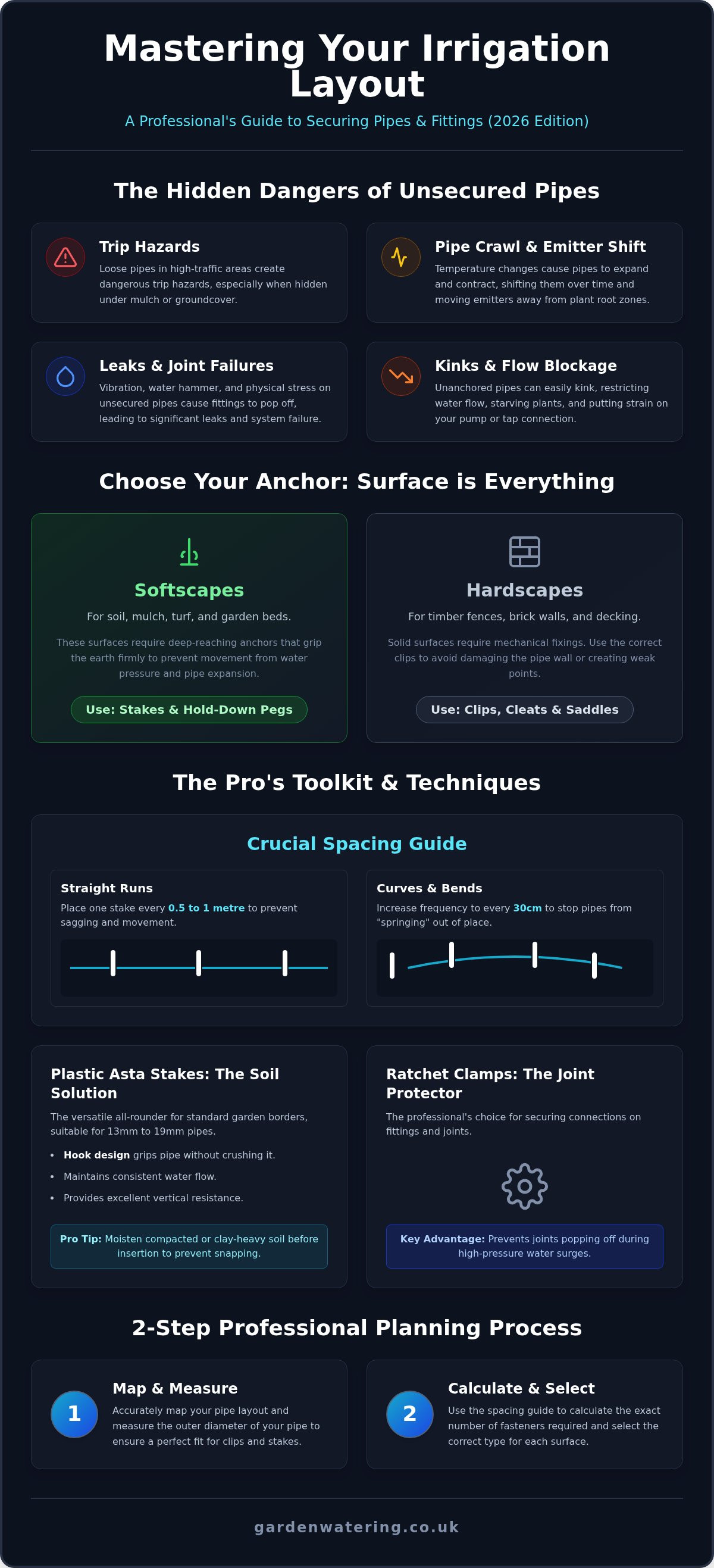
Installing Drip Irrigation Systems is a significant step toward garden efficiency, but the work isn't finished until the lines are secured. Without proper fasteners, your layout is subject to "pipe crawl." This phenomenon occurs when temperature fluctuations cause polyethylene pipes to expand and contract. Over a single season, this movement can shift emitters away from root zones or pull supply lines across garden pathways. Using high-quality irrigation hold down stakes, clips, cleat's,ratchets & saddles ensures your system stays where you intended, protecting both your plants and your peace of mind.
Beyond system performance, stability is a safety requirement. Unsecured pipes in high-traffic areas quickly become trip hazards, especially when hidden under light mulch or groundcover. Properly anchored lines also prevent kinking, which restricts water flow and puts unnecessary strain on your pump or tap connection. A neatly pinned system doesn't just look professional; it stays protected from lawnmowers and foot traffic that could otherwise cause expensive damage to your investment.
Preventing System Failure Through Stability
Mechanical stability is the silent guardian of a leak-free garden. When pipes are allowed to vibrate or shift, they place constant stress on Hozelock connectors and other sensitive joints. This movement is often exacerbated by "water hammer," the shockwave sent through the lines when a timer shuts off the water flow abruptly. A hold-down stake acts as a fundamental anchor that preserves the entire system's hydraulic integrity by preventing mechanical stress on joints. By eliminating this vibration, you significantly reduce the risk of fittings popping off during high-pressure cycles.
Softscape vs. Hardscape: The Basic Distinction
The surface you're working on dictates the hardware you need. Softscape areas like soil, mulch, or lawns require deep-reaching pegs that grip the earth firmly. In contrast, hardscapes like timber fences or brick walls need nail-in clips or screw-fixed saddles. Choosing the wrong fastener can lead to system migration or even physical damage to the pipe wall if the fit is too tight. For more inspiration on laying out your network, explore our Design Ideas and Plans to see how professional-grade fasteners complete a high-performance installation.
Securing Pipes in Soil: Stakes and Hold Down Pegs
Securing your irrigation lines in garden borders requires a reliable anchor to prevent the pipe from shifting over time. While some installers rely on the weight of mulch to hold lines down, this rarely provides enough stability against the water pressure surges common in home systems. Choosing the correct irrigation hold down stakes, clips, cleat's,ratchets & saddles ensures your layout stays buried and functional, even in high-traffic areas. Without these anchors, the natural expansion and contraction of the plastic can cause lines to migrate, potentially pulling emitters away from the plants they're meant to water.
For most residential projects, we recommend a spacing of one stake every 0.5 to 1 metre. If your route includes sharp curves or changes in elevation, you'll need to increase this frequency to every 30cm to prevent the pipe from "springing" out of the ground. When securing pipes under decorative bark or mulch, the stakes act as the primary defense against floating lines. Mulch is light and porous; it won't hold a pressurized pipe in place on its own. By pinning the pipe directly into the subsoil before adding your top dressing, you ensure the system remains invisible. This technique also protects the tubing from UV exposure, which can degrade polyethylene over several years if left uncovered.
Plastic Asta Stakes: The Versatile All-Rounder
Plastic Asta stakes are the preferred choice for standard garden borders and drip irrigation systems. Their unique "hook" design is engineered to grip the outer wall of 13mm to 19mm pipes without crushing the internal diameter. This maintains consistent water flow while providing excellent vertical resistance. When working with compacted or clay-heavy UK soils, it's helpful to moisten the ground before insertion. This prevents the plastic from snapping and allows the stake to seat fully into the earth. You can find professional installation diagrams for these components in Rain Bird's Drip Application Guide, which highlights the importance of proper stake depth for system longevity.
Metal Galvanised Pegs for Heavy-Duty Use
In environments where plastic may fail, such as rocky ground or permanent commercial installations, metal galvanised pegs are the superior option. These U-shaped fasteners offer exceptional longevity and rust-resistance in damp UK soil conditions. They're particularly effective for securing larger 19mm supply pipes that carry higher volumes of water and exert more force on the corners of your layout. If you're building a comprehensive system, it's wise to choose high-quality watering components that match the durability of your fasteners to ensure years of trouble-free operation. These metal anchors provide the heavy-duty grip needed to keep main supply lines stationary even during significant pressure fluctuations.
Vertical and Hardscape Fixing: Clips, Cleats, and Saddles
Running irrigation lines along hard surfaces requires a different approach than soil-based installation. While ground pegs work for soft borders, vertical runs and hardscapes need a mechanical fix that won't loosen due to wind or pipe vibration. Selecting the right irrigation hold down stakes, clips, cleat's,ratchets & saddles depends entirely on your surface material and the weight of the water-filled pipe. The goal is to keep the pipe straight and secure without compressing the tube wall. If a clip is too small or hammered too deep, it will "pinch" the pipe, creating a bottleneck that reduces water pressure at the emitters further down the line.
Understanding the difference between a cleat and a saddle is vital for long-term stability. A cleat is typically a one-sided fastener that's quick to install but offers less resistance to pulling forces. In contrast, a saddle provides a full bridge over the pipe with two points of contact. This double-sided anchoring is the preferred choice for high-traffic areas or vertical drops where the weight of the water puts constant downward pressure on the fixings.
Nail-In Wall Clips for Timber and Soft Masonry
Running a supply line along a fence rail is a great way to keep your garden layout tidy and out of the way of lawnmowers. To achieve a professional finish, match your clip size exactly to the external diameter of your pipe; a 13mm clip is standard for most drip lines, but 14mm variants are necessary for heavy-duty LDPE tubes. Space these clips every 40cm to 50cm to prevent the pipe from sagging between fixings, especially when the system is under pressure. It’s essential to use UV-stabilised clips for south-facing walls to prevent the plastic from becoming brittle and snapping under the sun's intensity.
Pipe Saddles for High-Security Fixing
For more permanent installations on brickwork or stone, screw-fixed saddles provide the highest level of security. Unlike nail-in clips, which can eventually work themselves loose from masonry, saddles use a bridge design that anchors the pipe on both sides. This is particularly important when supporting heavier pop-up lawn sprinkler systems where the pipe might be connected to heavier manifold components or subject to significant water hammer. When installing these on brick, always use a dedicated masonry bit and a high-quality wall plug to ensure the screw doesn't vibrate loose over time. Saddles offer several advantages for professional installations:
- Double-sided anchoring for maximum vertical stability
- Resistance against the "pull" of heavy water-filled pipes on long drops
- A professional, flush finish that mimics permanent plumbing layouts
Leak Protection: Ratchet Clips and Hose Clamps
The primary cause of system failure isn't usually a burst pipe, but a joint that has worked itself loose. Standard friction fits rely on the internal barb of a connector gripping the pipe wall. While this works for low-pressure gravity systems, it often fails under the rigours of mains-fed irrigation. High-performance systems require more than just irrigation hold down stakes, clips, cleat's,ratchets & saddles; they need mechanical seals at every junction. Ratchet clips provide a mechanical lock that standard joiners simply can't match. By applying external pressure around the entire circumference of the pipe, they eliminate the "popping off" problem that ruins many installations.
The Mechanics of the Ratchet Clip
Ratchet clips use a series of interlocking teeth to create a 360-degree seal. As you tighten the clip, the teeth click into place, ensuring the pipe is compressed firmly against the internal barb of your irrigation fitting adaptors. To get the perfect seal, use a pair of pliers to engage the final "click." This provides a far more secure connection than hand-tightening alone. It's precise. It's dependable. Most importantly, it's designed to avoid over-tightening which could crack the fitting.
When Ratchets are Non-Negotiable
There are specific scenarios where these clamps are essential. If you're using garden irrigation water timers, your system will experience significant pressure spikes every time the valve snaps shut. This "water hammer" effect can easily blow a standard friction fit apart. Don't risk a flooded garden. Similarly, in greenhouses or south-facing borders, the sun's heat can soften polyethylene pipes. This causes them to expand and lose their grip on internal barbs. A ratchet clip ensures the joint remains watertight regardless of the ambient temperature or pressure surges.
Most professional-grade ratchet clips are reusable. You can simply lever the teeth apart with a flat-head screwdriver if you need to adjust your layout. This makes them a superior choice over permanent metal crimp rings for gardeners who like to refine their systems over time. They offer flexibility without compromising on strength. To complete your setup with the highest standard of hardware, view our professional drip irrigation components.
Choosing the Right Fasteners for Your Project
Selecting the right hardware is the final step to completing your system. You should never guess your pipe size; always measure the external diameter before ordering. While internal connectors are often sized by the bore, irrigation hold down stakes, clips, cleat's,ratchets & saddles are sized to fit the outside of the tube. This distinction is vital for a snug, professional fit. Next, map your route to determine how many ground-level stakes versus wall-mounted clips you require. For curves and corners, plan for extra anchors. Pipes have material memory and will try to straighten, so placing a stake every 30cm on a turn is a professional best practice. Finally, ensure your fasteners are compatible with your system brand, such as Hozelock or Antelco, to guarantee the components work together seamlessly.
The 'Essential Ten' Selection
Our curated Hold Down Stakes and Clips collection features ten professional-grade tools designed specifically for UK garden conditions. Whether you're securing a 13mm drip line or a 19mm main supply pipe, choosing the right tool for the specific surface ensures a neat, long-lasting finish. We recommend purchasing in bulk packs of 10 or 25 for larger projects. This not only saves money but also ensures you have enough spares to handle unexpected changes in your garden layout. Before you hit the checkout, double-check that you've accounted for every junction and vertical drop in your plan to avoid mid-project delays.
Common Installation Mistakes to Avoid
Even with the best hardware, poor technique can lead to system failure. Over-spacing your stakes is a frequent error. If you place them too far apart, the pipe will bow as it heats up, creating trip hazards and pulling emitters out of place. Another critical mistake is using indoor cable clips for outdoor irrigation. These lack UV stabilisers and will become brittle and snap within a single season of sun exposure. Don't forget to secure the pipe near the tap connection as well. This is the point of highest vibration and pressure, so it requires a sturdy anchor to prevent the fittings from working loose over time. By avoiding these simple errors, you'll ensure your system remains efficient and maintenance-free for years to come.
Build Your Professional Irrigation Layout Today
Securing your system is the essential final step in transforming a collection of pipes into a high-performance network. By selecting the right irrigation hold down stakes, clips, cleat's,ratchets & saddles, you protect your garden from trip hazards and ensure water reaches the root zone. Whether you're anchoring lines into heavy soil or running a drip line along a fence, professional-grade fasteners are key. It's the difference between a temporary fix and a permanent solution. Your system should stay exactly where you installed it.
Since 2011, we've provided expert UK advice to help gardeners master their outdoor spaces. Our specialist Hozelock-compatible hardware is designed for local conditions and comes with fast UK shipping. We're dedicated to your success. Shop the Full Range of Irrigation Hold Down Stakes and Clips and take control of your garden layout with hardware you can trust. We look forward to helping you create a watering system that performs reliably for years to come.
Frequently Asked Questions
How many hold-down stakes do I need per metre of irrigation pipe?
You should typically install one hold-down stake every 0.5 to 1 metre along straight runs of irrigation pipe. If your layout includes sharp corners or significant changes in elevation, increase this to one stake every 30cm to 50cm. This prevents the natural memory of the plastic pipe from pulling it out of position. Proper spacing ensures your lines stay buried under mulch and remain invisible throughout the growing season.
Can I use metal stakes with plastic irrigation pipes?
Yes, metal stakes are an excellent choice for securing plastic pipes in rocky ground or compacted clay where plastic pegs might snap. Galvanised U-shaped pegs offer superior longevity and rust resistance in damp UK soils. They provide a heavy-duty anchor for larger 19mm supply lines that carry higher water volumes. Just ensure the peg is wide enough to bridge the pipe without pinching or puncturing the wall during installation.
What is the difference between a 13mm and a 14mm pipe clip?
The difference lies in the external diameter of the pipe they are designed to secure. A 13mm clip fits standard drip irrigation lines, while 14mm clips are required for heavy-duty LDPE supply pipes with thicker walls. Using the wrong size can either leave the pipe rattling loosely or crush the tube, which restricts water flow. Always measure the outside of your pipe before selecting your irrigation hold down stakes, clips, cleat's,ratchets & saddles.
Do I need special tools to install irrigation ratchet clips?
You don't need dedicated professional tools, but a standard pair of pliers is highly recommended for a secure installation. While you can often push the ratchet teeth together by hand, using pliers allows you to engage the final "click" for a watertight, 360-degree seal. This mechanical lock is vital for preventing leaks at joints when your system experiences pressure surges from a water timer or high-pressure mains supply.
Will nail-in clips work on a brick wall?
Nail-in clips are primarily designed for timber fences and soft masonry. While they can be hammered into some mortar joints, they may vibrate loose over time on hard brickwork. For a permanent fix on brick walls, we recommend using screw-fixed pipe saddles with wall plugs. This provides a much stronger anchor that won't pull out when the pipe is full of heavy water or subjected to wind and frost heave.
How do I stop my irrigation pipe from popping off the fitting?
The most effective way to stop pipes from popping off is to install ratchet clips over every barbed connection. Standard friction fits often fail during the pressure spikes caused by automatic timers or high-pressure taps. A ratchet clip creates an external mechanical lock that holds the pipe firmly against the internal barb. This simple addition eliminates the most common cause of irrigation leaks and system failure in domestic gardens.
Are these clips and stakes UV resistant for UK summers?
Yes, all professional-grade fasteners in our collection are manufactured from UV-stabilised materials to withstand UK summer conditions. Standard indoor cable clips will quickly become brittle and snap when exposed to direct sunlight, but specialist irrigation hold down stakes, clips, cleat's,ratchets & saddles are designed for long-term outdoor use. This durability ensures your pipework remains securely anchored for many years without the plastic degrading or losing its grip.
Can I reuse ratchet clips if I move my irrigation system?
Most ratchet clips are fully reusable, making them ideal for gardeners who like to adjust their layouts. You can easily remove them by inserting a small flat-head screwdriver into the locking mechanism and gently levering the teeth apart. This flexibility allows you to reconfigure your drip lines or move your system to a new area of the garden without having to purchase entirely new hardware every time you make a change.
`-
Posted in
cleat's, clips, DIY, garden maintenance, gardening, irrigation, irrigation hold down stakes, irrigation stakes, landscaping, pipe clips, ratchet clamps, ratchets & saddles, watering systems