
Irrigation Microjets & Sprays: A Buyer’s Guide to Targeted & Efficient Watering
What if your current watering routine is actually starving your plants while inflating your utility bills? It's a common frustration to see water pooling on paving slabs while the root zones of your favourite shrubs remain bone dry. Understanding how to implement irrigation microjets & sprays | targeted & efficient watering solutions is the secret to moving away from guesswork and towards a truly professional result. We know that technical terms like bar pressure and flow rates can feel overwhelming, but getting these details right is what transforms a struggling border into a thriving landscape.
You're likely looking for a way to keep your garden vibrant without spending hours with a hose or wasting precious resources. We've spent 15 years specialising in high-quality systems to help gardeners just like you find that perfect balance. This guide will help you choose the ideal micro spray patterns and flow rates for your specific soil and plant types. You'll learn how to create a system that's easy to adjust as your garden grows, ensuring a lush, healthy garden with lower water bills and much less effort. By the end of this guide, you'll have the confidence to build a bespoke setup that delivers water exactly where it's needed most.
Key Takeaways
- Understand how microjets use a fine, atomised mist to cover wider garden areas more efficiently than standard individual drippers.
- Learn how to choose the ideal irrigation microjets & sprays | targeted & efficient watering solutions by matching 90°, 180°, and 360° patterns to your specific garden layout.
- Master the "Bucket Test" to accurately calculate your home’s flow rate and ensure your system perfectly matches your available bar pressure.
- Compare the maintenance needs and coverage benefits of micro sprays versus drippers to select the most reliable system for your borders.
- Discover the most effective components from our curated 11-piece collection, including specialist solutions for full-circle saturation in larger landscapes.
Understanding Irrigation Microjets & Sprays: Why Targeted Watering Matters
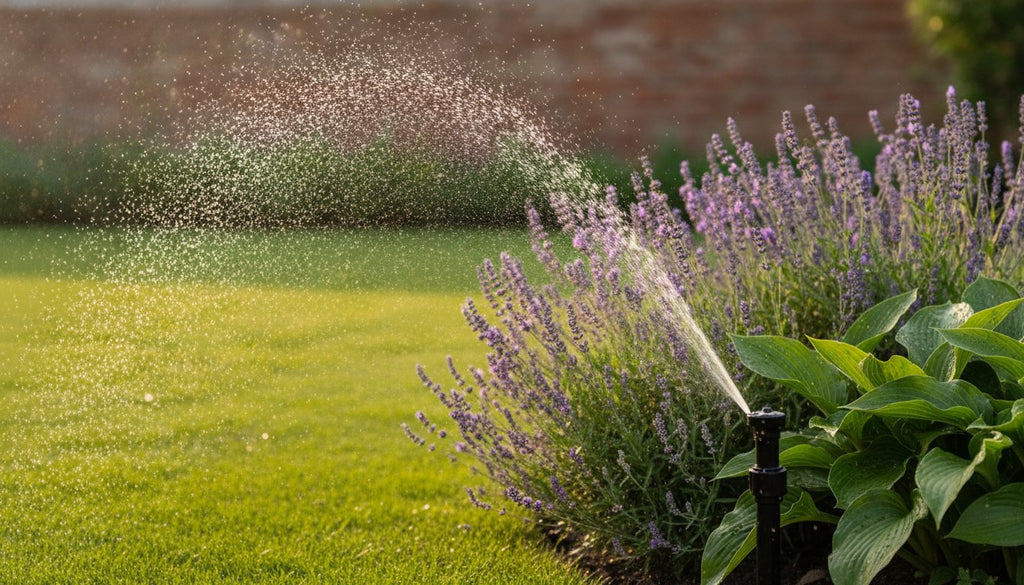
Microjets and sprays are low-volume emitters designed to deliver water as a fine, atomised mist. Unlike standard drippers that focus on a single point, these components provide broader coverage for flower beds and borders with minimal effort. When you integrate irrigation microjets & sprays | targeted & efficient watering solutions into your garden, you move away from the "hit-and-miss" nature of manual watering. These systems ensure that moisture reaches the root zone without the heavy runoff often seen with traditional methods.
A professional Micro-irrigation system prioritises precision. We've seen how gardeners often struggle with water landing on garden paths or foliage rather than the soil. By using targeted emitters, you avoid this waste entirely. This transition transforms watering from a repetitive gardening chore into an automated, healthy ecosystem. It's a reliable way to maintain a lush landscape while keeping your water bills manageable. To better understand how these components function in a real-world setting, watch this helpful video:
The Science of the Fine Mist
Atomised water is particularly effective because it improves absorption in delicate soil types. When water is broken down into tiny droplets, it infiltrates the ground slowly. This prevents the surface "crusting" that often happens with heavy rain or high-pressure hose guns. For fragile seedlings and greenhouse environments, a fine mist is superior as it provides hydration without the physical impact that can damage young stems. It also significantly reduces soil erosion, keeping your nutrients exactly where your plants need them. If you are looking for a comprehensive setup, a Hozelock Automatic Watering System can be tailored to include these specialised misting components.
Microjets vs. Traditional Sprinklers
Traditional lawn sprinklers are high-volume tools that often lead to significant water waste through evaporation and wind drift. In contrast, micro-irrigation offers a level of precision that makes it the better choice for densely planted borders. You can position microjets low to the ground, ensuring water is delivered beneath the leaf canopy. This has an aesthetic advantage too. These components are discreet and don't disrupt your garden design like bulky oscillating sprinklers. They provide a "fit-and-forget" luxury, allowing your garden's beauty to remain the focal point while the technical work happens quietly in the background.
Key Features to Compare When Choosing Your Micro Sprays
Selecting the right components for your garden doesn't have to be a guessing game. By understanding the specific capabilities of irrigation microjets & sprays | targeted & efficient watering solutions, you can tailor your system to the exact needs of your plants. This level of precision is what separates a basic setup from a truly professional landscape. We often see customers overwhelmed by technical specs, but focusing on three main areas; pattern, flow, and radius; makes the process straightforward and effective.
Matching the Pattern to the Plot
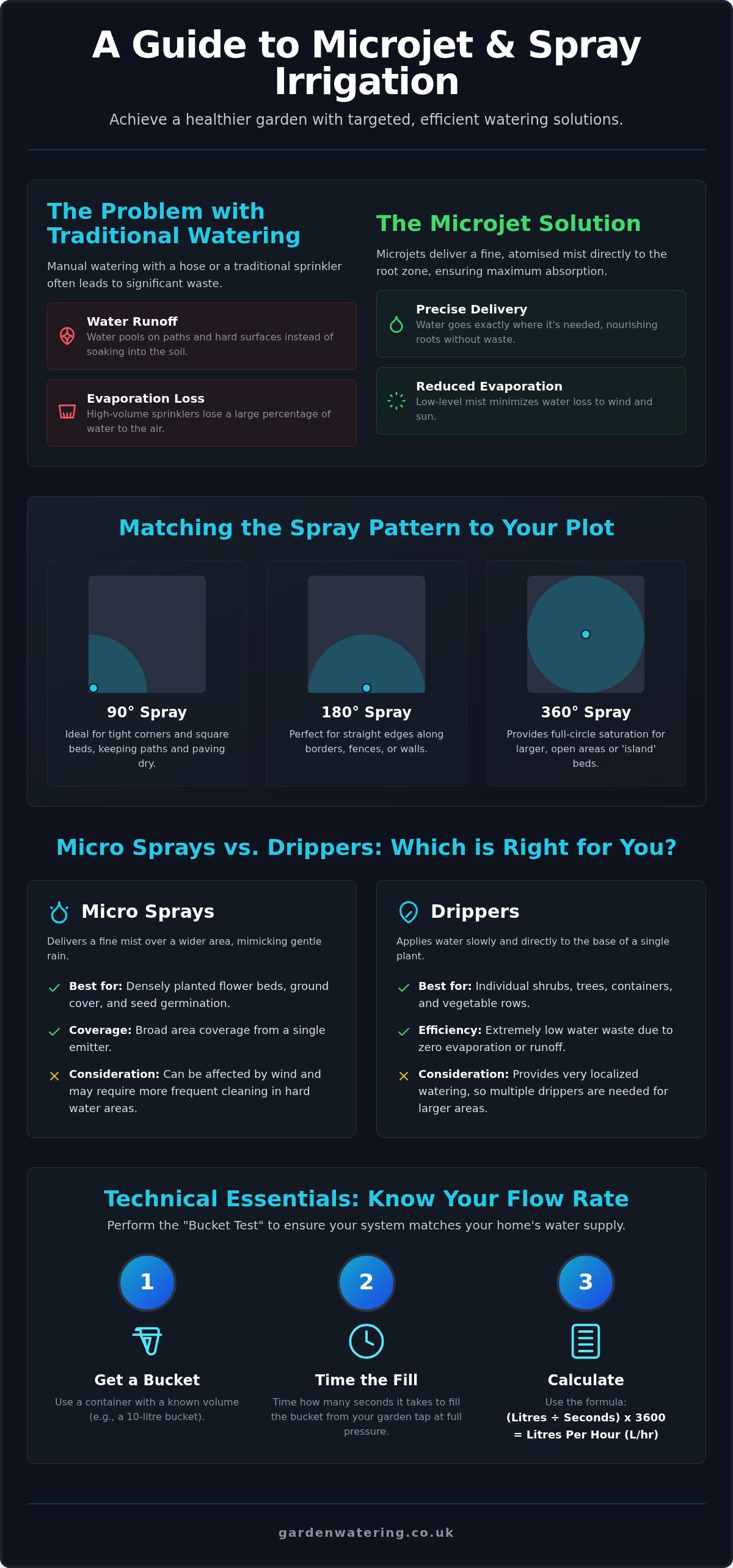
Garden layouts are rarely simple rectangles. You should use a 90° spray for tight corners to keep paths dry and prevent algae growth on paving. A 180° pattern works best along the edges of a straight border or fence line, directing every drop toward the soil. For larger, open areas, a 360° "centre-of-bed" spray provides maximum saturation across a wider area. If you are managing narrow planters or long hedges, specialised strip patterns are the secret to preventing waste on either side of the planting line. This use-case matching ensures your greenhouse plants get a different treatment than your hardy outdoor shrubs.
Flow Rates and Spray Radius
When choosing microirrigation emitters, you must balance the flow rate with your home's available bar pressure. Flow rates typically range from 18 L/h for delicate misting in greenhouses to 55 L/h for heavier border coverage. A standard micro spray has a radius between 1 and 3 metres. While a higher flow rate usually provides a larger radius, you must ensure your main supply pipe can support the total L/h of all emitters on the line. If the pressure is too low, the mist won't reach its intended distance, leading to uneven patches in your garden.
Fixed vs. Adjustable Flow Emitters
In our 15 years of experience, we've found that fixed-flow jets are perfect for established gardens where water needs remain constant. They offer a reliable "fit-and-forget" solution. However, adjustable Vari-Jets are essential for mixed-planting beds where young plants might need more water as they grow or as seasons change. If you have species like roses that are sensitive to leaf moisture, "Downsprays" are a clever solution. They deliver water in a downward cone, avoiding the foliage entirely to prevent disease. To see how these patterns fit into a complete system, explore our range of Hozelock watering components designed for effortless installation.
Micro Sprays vs. Drippers: Which Targeted Solution is Right for You?
Deciding between these two emitters often comes down to the specific geometry of your garden. While drippers are designed for pinpoint accuracy, microjets provide broader area coverage. In our 15 years of specialising in these systems, we've found that using irrigation microjets & sprays | targeted & efficient watering solutions is the most cost-effective way to manage large borders. You can often cover the same square footage with two or three microjets that would otherwise require a dozen individual drippers, reducing both your initial setup time and the complexity of your pipework.
Maintenance is a practical factor that many gardeners overlook. Microjets are significantly easier to inspect and clean because their output is visible. You can see the mist pattern from across the garden, making it easy to spot a partial blockage before your plants show signs of stress. Achieving efficient watering with microirrigation relies on this consistency. If a jet does become clogged with grit or limescale, most models allow you to simply unscrew the head and rinse it out, ensuring your system remains at peak performance for years.
A hybrid layout is often the most intelligent choice for a diverse UK garden. You aren't restricted to using just one type of emitter on your line. By utilising high-quality Hozelock connectors, you can branch off your main 13mm supply pipe to serve a row of pots with drippers while simultaneously misting a nearby flower bed with microjets. This flexibility allows your irrigation system to evolve alongside your planting scheme.
When to Choose Micro Sprays
Micro sprays are the premier choice for seedlings, greenhouses, and densely planted flower borders. The fine, atomised mist they produce helps maintain humidity levels in enclosed spaces, which is a major benefit for tropical plants or young starts. They are also the only effective way to water ground-cover plants. Because these plants spread horizontally, a single drip point isn't enough; the wide-reaching mist ensures the entire root mat stays hydrated without you having to install a forest of stakes and pipes.
When to Stick with Drip Irrigation
For individual shrubs, hanging baskets, or trees that require deep-root hydration, Drip Irrigation Systems are the better option. These emitters deliver water directly to the soil surface at a very slow rate. This approach is perfect for avoiding evaporation loss during the height of a dry UK summer. By keeping the water close to the ground, you ensure that moisture reaches the deeper roots of established plants rather than being lost to the wind or sitting on the foliage where it could encourage fungal issues.
The Technical Essentials: Flow Rates, Pressure, and Layout Planning
Your outside tap is the heart of any irrigation system. To ensure your irrigation microjets & sprays | targeted & efficient watering solutions perform as intended, you need to understand "Bar" pressure. A simple 15-year expert trick we recommend to every customer is the "Bucket Test". Place a 10-litre bucket under your tap and time how long it takes to fill. If it takes 30 seconds, your flow rate is 1,200 litres per hour. This figure is vital for planning your layout, as it dictates the total number of emitters you can run simultaneously without the mist turning into a weak dribble.
Connecting your jets requires a logical approach to pipework. You'll typically use a 13mm supply pipe for the main runs around your garden borders and 4mm micro pipes for the final reach to individual plants. Integrating Water Timers into this setup is the best way to maintain a healthy regime. Automation ensures your garden receives moisture at the optimal time, usually early morning, when evaporation rates are lowest and plants are most receptive.
Calculating Your System Capacity
Every hose line has a physical limit. If you install too many microjets on a single run, the pressure at the end of the line will drop, leading to uneven watering. Elevation is another factor that many gardeners overlook. 1 Bar of pressure is roughly equivalent to 10 metres of vertical lift. If your garden slopes upwards from the tap, your system has to work harder to push water against gravity. Planning your layout on a flat run or using shorter branches can help maintain a consistent spray radius for every emitter in the circuit.
Installation Tips for a Leak-Free System
Precision is key during the assembly phase. You can use a specialised hole punch tool to snap microjets directly into the 13mm main pipe for a low-profile look. Alternatively, T-junctions allow you to branch off with 4mm micro pipe for more flexible placement. The long-term reliability of your system depends on using high-quality Irrigation Fittings and Adaptors to ensure every connection remains secure under pressure. Don't forget to winterise your setup. We recommend flushing your microjets before the first frost to clear out sediment and then draining the pipes to prevent ice damage. To ensure your setup is built to last, browse our expert-selected Hozelock watering kits for a complete, high-performance solution.
Top Recommendations from the Irrigation Microjets & Sprays Collection
Choosing the right components is simpler when you have access to a curated range designed for specific garden challenges. Our 11-piece Irrigation Microjets & Sprays collection is the result of 15 years of testing and refinement in UK gardens. We've selected these parts to ensure that implementing irrigation microjets & sprays | targeted & efficient watering solutions is an effortless process for every gardener. Whether you are managing a sprawling border or a delicate greenhouse, there is a specific emitter designed to do the job perfectly.
For large flower borders, the 360° Micro Jet is our top recommendation. It provides full-circle saturation, making it ideal for central placement where you need consistent moisture across a wide radius. This ensures no dry patches are left behind, supporting the long-term health of your landscape. In contrast, greenhouse seedlings require a much softer touch. The Fine Mist Spray delivers delicate hydration that won't flatten young plants or disturb the soil. It's an essential tool for maintaining the high humidity levels that tropical species and young starts crave.
If you're new to automatic systems, pre-assembled kits are the best starting point. They take the guesswork out of part compatibility, providing everything you need to get your first zone up and running in minutes. These kits provide a reliable foundation that you can expand as your confidence and your garden grow.
Standout Products for Precision Watering
The Winged Micro Jet is a favourite among our regular customers. The small "wings" on the side of the head make it much easier to grip and adjust with your fingers, even in wet conditions. For beds that change every season, the Adjustable Vari-Jets are the ultimate all-rounders. You can increase or decrease the flow with a simple twist as your plants grow. If you have tall foliage that blocks a ground-level mist, using Micro Spray Stakes allows you to elevate the spray heads. This ensures the water clears the leaves and reaches the soil surface directly.
Building Your Complete Hozelock System
These sprays are fully compatible with Hozelock Watering Kits, allowing you to expand a basic setup into a comprehensive network. One expert tip we always share is to use a pressure regulator at the tap. This simple addition prevents high-pressure surges from causing your spray heads to "pop" off the pipework, ensuring your system remains reliable and leak-free for years. To find the perfect components for your next project, you can browse the full Microjets & Sprays collection here.
Transform Your Garden with Precision Watering
You now have the knowledge to move beyond basic watering and implement a system that truly supports your garden's health. By matching specific spray patterns to your borders and accurately calculating your flow rate, you ensure every plant receives exactly what it needs. Choosing irrigation microjets & sprays | targeted & efficient watering solutions is a commitment to both garden performance and environmental responsibility. It's about creating a dependable ecosystem that thrives with minimal manual intervention.
As a specialist Hozelock UK retailer with 15 years of industry experience, we're here to act as your dedicated partner in gardening success. Our team provides the expert advice required to build a reliable system that grows alongside your landscape. With next-day delivery available on most UK orders, you can start your installation sooner than you think. Shop the Irrigation Microjets & Sprays Collection today to secure high-quality components for your home. We're confident that with the right tools, you'll enjoy a more vibrant, water-efficient garden for years to come.
Frequently Asked Questions
How many microjets can I run off one outside tap?
You can typically run between 15 and 25 microjets from a single outside tap, depending on your home's specific flow rate. We recommend performing a "Bucket Test" to find your exact capacity. If your tap delivers 1,200 litres per hour and each jet uses 55 litres, you shouldn't exceed 20 units on one line. Exceeding this limit causes the pressure to drop, resulting in poor coverage at the end of the system.
Do I need a special tool to install micro sprays into my irrigation pipe?
You will need a specialised hole punch tool to install micro sprays directly into a 13mm supply pipe. This tool creates a clean, precise 4mm aperture that ensures a watertight fit for the emitter's threaded base. While you can use T-junctions for some layouts, the punch tool is the most efficient way to place jets exactly where your plants need them. It's a simple, inexpensive addition to your toolkit that prevents leaks.
What is the difference between a 180-degree and a 360-degree micro spray?
The main difference lies in the spray pattern and where you place them in your garden layout. A 180-degree spray is designed for the edges of borders or alongside paths, directing water forward into the soil. A 360-degree spray provides full-circle saturation and is best placed in the centre of large flower beds. Choosing the right pattern for irrigation microjets & sprays | targeted & efficient watering solutions ensures you don't waste water on your paving.
Can I use microjets for my vegetable patch or are they only for flowers?
Microjets are excellent for vegetable patches, particularly for leafy greens like lettuce or spinach that benefit from increased humidity. The fine mist provides gentle hydration without compacting the soil around delicate root systems. However, for large individual plants like tomatoes or pumpkins, you might prefer combining them with drippers for deep-root watering. Using a hybrid system allows you to tailor the delivery to each specific crop's requirements for a healthier harvest.
Why is my micro spray only producing a weak dribble instead of a mist?
A weak dribble usually indicates either a blockage in the nozzle or insufficient bar pressure in your system. First, unscrew the spray head and rinse it to clear any trapped grit or limescale. If the problem persists across the whole line, you may have too many emitters installed for your tap's flow rate. Reducing the number of jets or splitting the system into two zones with a water timer often resolves these pressure issues.
Will these microjets work with my existing Hozelock system components?
Yes, our curated collection is fully compatible with standard Hozelock automatic watering systems and 4mm micro pipes. We specialise in Hozelock and high-quality UK brands to ensure that every fitting connects securely without the need for adapters. Whether you're adding to an existing kit or building a bespoke layout, these components integrate seamlessly. This compatibility makes it easy to upgrade your garden with irrigation microjets & sprays | targeted & efficient watering solutions over time.
How often should I clean the nozzles on my micro sprays?
We recommend inspecting and cleaning your nozzles at least once per season, typically in late spring before regular watering begins. If you live in a hard water area, limescale can build up more quickly, so keep an eye on the spray pattern. If the mist looks uneven or restricted, simply unscrew the head and soak it in a mild descaling solution or rinse it under a tap to restore full performance immediately.
Can I leave microjets in the garden during a UK winter?
You can leave the components in place, but you must winterise the system to prevent frost damage. Before the first freeze, disconnect the system from the outside tap and allow all water to drain from the pipes. We also suggest removing any end plugs to ensure no standing water remains inside. Frozen water expands and can split the plastic fittings or the supply pipe itself, so thorough draining is the best way to protect your investment.
`-
Posted in
DIY irrigation, garden maintenance, gardening tips, irrigation, irrigation microjets & sprays | targeted & efficient watering solutions, micro sprays, microjets, water conservation, watering systems