Drippers for Every Occasion: How to Choose the Right Type
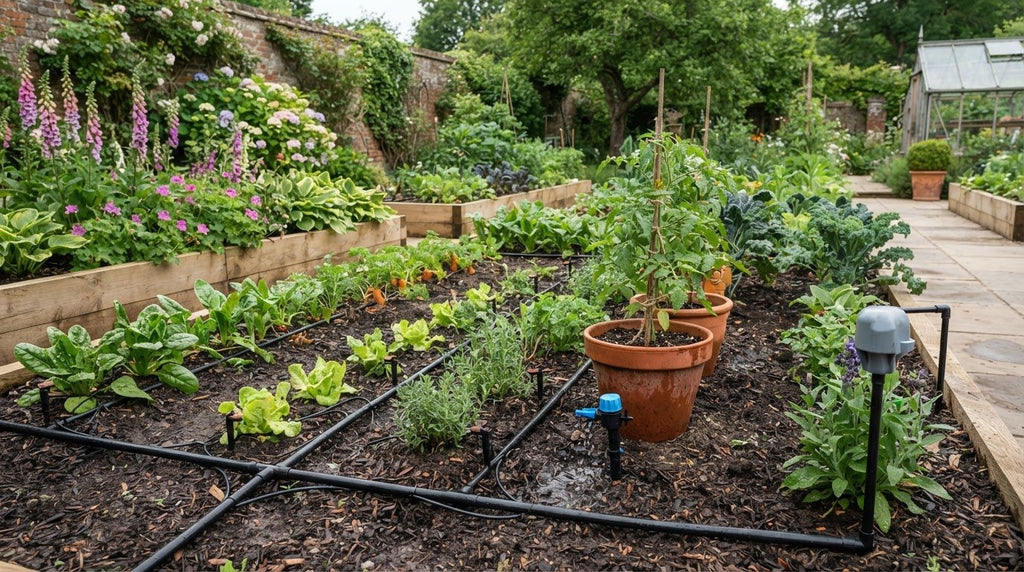
The highest-flow dripper isn’t automatically the right choice. A pot at the end of a pipe run may need a different emitter from a plant beside the main line, even if both need regular watering. We have a large selection of drippers for any ocassion, with options for different plant positions and irrigation layouts. To narrow down the choice, compare where each dripper connects, how much water it is designed to deliver and whether its flow can be adjusted.
The best starting point is your planting layout. This guide compares fixed-flow, adjustable and pressure-compensating emitters, and explains when inline or end-of-line placement may suit pots, rows, planters and borders. You’ll also find practical steps for mapping a system and keeping the emitter type consistent along each pipe run. Garden Watering has over 15 years of experience advising on watering systems, helping you compare options for your garden.
Key Takeaways
- Match inline drippers to plants along a row and end-of-line options to individual positions such as pots and planters.
- Compare fixed 4 L/h emitters with adjustable options offering a 0-40 L/h range, and choose based on your layout and watering needs.
- Pressure-compensating drippers are designed to maintain their stated flow within their operating conditions. Check the specifications for each emitter.
- Use a simple selection process: map your plants, plan the tube route, choose outlet positions, then compare flow rates.
- With 26 products, we have a large selection of drippers for any ocassion, including Hozelock, Antelco and pressure-compensating options.
What are garden drippers, and which plants are they suited to?
A garden dripper is an emitter that releases water at a chosen plant or root zone, rather than spraying across a broad area. This targeted delivery can suit containers where each plant has its own watering needs, including pots, tubs and hanging baskets. In planted borders, you can position emitters along the bed to direct water towards selected plants instead of wetting the whole surface.
Drippers release water in drops or a controlled stream near the soil. Micro-jets spray over a wider area and use more water. They suit different layouts, but their flow rates differ, so never fit drip drippers and micro-jets on the same pipe run. For an overview of the principles and components used in drip irrigation systems, see the reference here.
The video below discusses pour-over coffee drippers, not garden irrigation, so it doesn’t demonstrate the garden products described here. The guidance in this article focuses on matching garden emitters to plant positions and tube routes.
Start by noting where each plant sits, then plan the route of the irrigation tube. A line that passes a row of plants may need emitters along the tube, while scattered containers may be easier to water with an outlet at each position. This quick layout check helps narrow the options before you compare flow rates or settings. We have a large selection of drippers for any ocassion, with formats for different planting arrangements.
Inline or end-of-line drippers: where does each one fit?
Inline emitters sit along a 4mm micro tube, making them useful when the tube runs past a row of plants. Hozelock 2784 is an example of an inline option. End-of-line emitters attach at the end of a tube serving a particular plant, which can suit separate pots or spaced planting positions; Hozelock 2785 is an example of this arrangement. First decide whether the tube will pass each plant or branch out to individual locations, then choose the fitting to match.
When are stake-mounted drippers useful?
A stake holds the outlet beside a plant, helping direct water towards its root zone instead of leaving the outlet wherever the tube falls. This can be practical in hanging baskets, tubs and individual pots, where plants are separated and the tube needs to reach into each container. Hozelock Adjustable Stake Drippers 2788 are one option in this format. Place each stake near the plant you want to water, and plan a neat route for the tube to reach it.
For a border or mixed container layout, sketch the plant positions and tube route before choosing emitters. The sketch helps you decide where water should leave the line and whether inline, end-of-line or stake-mounted placement best suits the arrangement. Explore the drip irrigation collection to compare formats for your planting plan.
How do dripper flow rates and adjustable settings compare?
A dripper’s flow rate is its stated water output over time, usually shown in litres per hour (L/h). A 4 L/h emitter is specified to deliver four litres in an hour under the conditions it is designed for. This figure helps you compare products, but it isn’t a watering duration. How long to run a system depends on the plants and setup, so don’t treat the rating as a guarantee of a particular result.
Fixed-flow emitters have a set output, while adjustable models let you change the flow at each emitter. That difference matters if one run serves plants with varying watering requirements. We have a large selection of drippers for any ocassion, including options with different placements and output settings to suit your layout.
| Example | Placement | Stated flow | Adjustability | Suitable layout |
|---|---|---|---|---|
| Hozelock 2784 | Inline | 4 L/h | Fixed | A row served by tube passing the plants |
| Antelco CETA | Fixed-flow dripper | 4 L/h | Fixed | Positions where a steady stated output suits the plan |
| Antelco adjustable models | Model-dependent, including stake options | 0-40 L/h | Adjustable from off to the stated maximum | Individual plants or layouts needing varied emitter settings |
Fixed-flow drippers: when is a steady 4 L/h output useful?
A fixed 4 L/h dripper provides the same stated output from each emitter of that type. This can make planning more straightforward when plants along a section have similar watering requirements. Hozelock 2784 and Antelco CETA are examples with a stated 4 L/h flow. They differ in product format, so consider the pipe arrangement as well as the rating. A fixed output simplifies emitter settings, but it doesn’t mean every plant needs the same run time.
Adjustable drippers: how much control do they offer?
Antelco adjustable models can be set from off to 40 L/h. You can change the flow at an individual emitter instead of relying on one preset output. This can be useful when plants on a run vary, although settings should still suit the system and planting plan. Some matching Antelco stake models provide 180° or 360° patterns. Choose the pattern that fits the outlet’s position and the area you want to water.
Compare the output and layout together, rather than choosing by flow rate alone. A high maximum flow isn’t automatically better; the useful setting is one that fits the plant position and watering plan. Browse the dripper selection to compare emitter formats and specifications.
Does pressure compensation matter when choosing garden drippers?
Pressure compensation is a feature intended to help a dripper maintain its stated flow as pressure varies within the product’s designed operating conditions. It may be worth considering when emitters sit at different points along a pipe run and you want to compare models designed for consistent output. The feature describes the product; it doesn’t promise identical results from every emitter in every installation.
Use the stated flow and outlet arrangement to narrow your choice, then consider the pipework and system setup. Pressure compensation doesn’t replace a suitable layout or routine maintenance. A blocked emitter, unsuitable operating conditions or an incompatible connection can still affect performance. We have a large selection of drippers for any ocassion, including pressure-compensating options from Hozelock, Antelco and Netafim.
When might pressure-compensating drippers suit a pipe run?
If a line serves plants at different positions, a pressure-compensating model may be useful to compare. Hozelock 7040 has a stated 4 L/h output. Antelco Asta options have stated flows of 2, 4 or 8 L/h. Compare these ratings with the planned watering points and emitter requirements. Pressure compensation doesn’t make different flow rates interchangeable.
Keep the whole run consistent, too. Drip drippers and micro-jets operate at different flow rates, so don’t mix them on the same pipe run. Check the emitter type and stated output across the line, and consider the route and connections as part of the system, not just the pressure-compensating feature.
How do drippers differ by connection and outlet arrangement?
Connection style affects how an emitter fits into your layout. Inline fittings sit along a tube, while end-of-line outlets serve a position at the tube’s end. These formats aren’t universally interchangeable, so match the connection to the pipe and planned position. The 4-way Spider Dripper distributes water through four pre-fitted micro tubes, which can serve several nearby watering points from one fitting.
Netafim end-of-line models offer another layout choice, with stated 2 or 4 L/h variants. Compare the outlet position and flow with your planting layout; don’t select by brand or pressure compensation alone. Browse the drip irrigation systems collection to compare compatible formats for a garden setup.
A useful shortlist starts with three questions: where will each emitter sit, what flow is stated, and how does the fitting connect to your tube? Pressure compensation can help distinguish products where maintaining the listed flow is a priority, while suitable setup and upkeep remain essential. Explore the dripper options to compare arrangements and stated outputs.
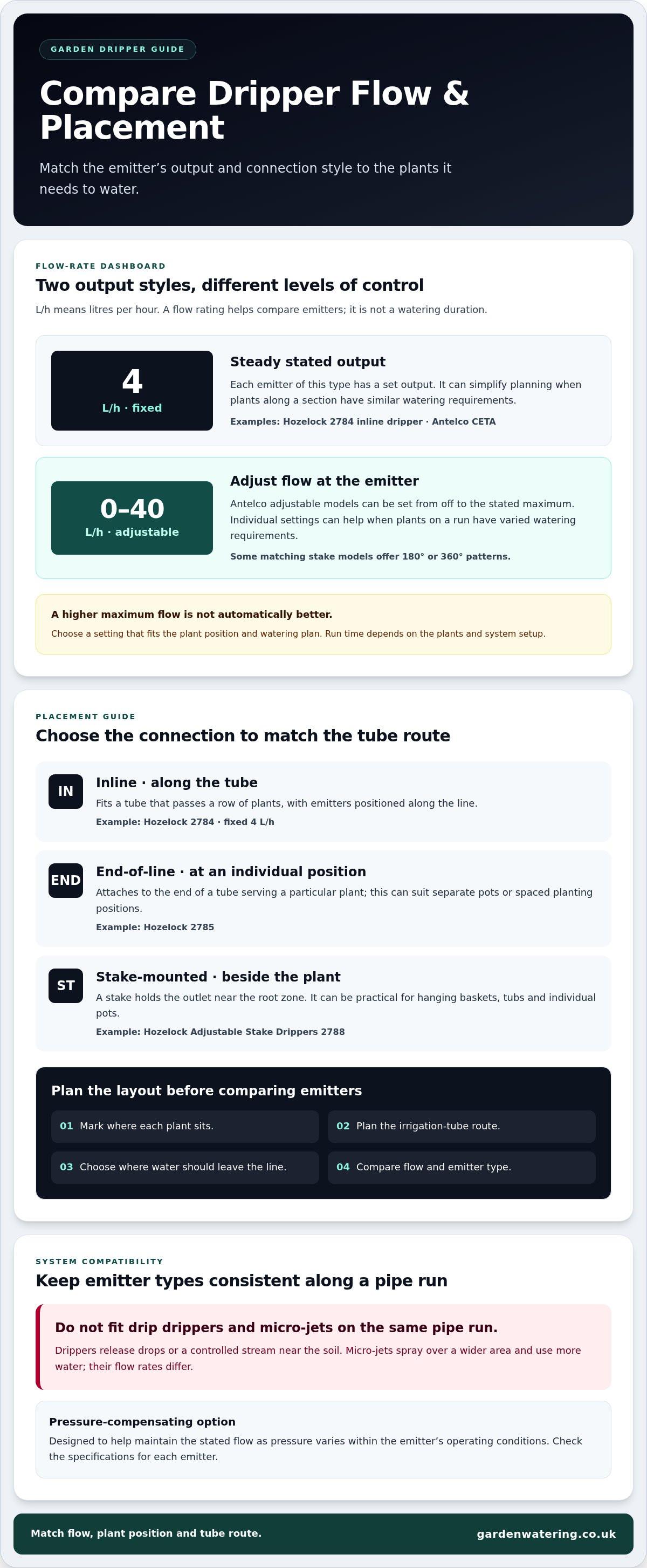
How can you match drippers to pots, rows and garden borders?
Choose emitters by working outwards from the planting plan. Mark where plants sit, trace the tube route, decide where each outlet needs to be, then compare suitable dripper formats and flow options. This helps prevent outlets landing between pots or on the wrong side of a border plant.
- Map the plants. Note individual pots, groups of containers, rows and border plants.
- Identify the tube route. Plan whether the micro tube will pass each plant or branch towards separate positions.
- Choose outlet positions. Decide if water should leave the tube along its length, at the end, or through a stake placed by a plant.
- Compare the emitters. Check their connection, stated flow and outlet pattern against the layout.
For a row, an inline format can serve positions along one micro tube. For separate pots, end-of-line spikes or stake-mounted outlets can direct water to individual locations. If an emitter has a half-circle or full-circle pattern, match it to its position: a half-circle pattern may suit an edge position aimed into the planting, while a full-circle pattern can suit a central position where water needs to spread around it. Use the stated pattern to orient the outlet.
Which drippers suit individual pots, tubs and hanging baskets?
For a single pot, compare an end-of-line spike with a stake-mounted option. The best fit depends on where the tube can reach and where the outlet needs to sit. The 4-way Spider Dripper feeds four pre-fitted micro tubes, offering a way to serve one large pot or distribute outlets among several smaller pots. Antelco Drip Pets are decorative 4 L/h options; position each outlet according to the plant’s location, regardless of its appearance.
What should you consider for rows, planters and border runs?
Where plants follow a line, an inline dripper can serve multiple positions along a micro tube. Hozelock 7042 and Netafim inline options are examples to compare for this arrangement. Keep the route simple by following the row or planter edge, then place outlets where the plants are. For separate plants, an end-of-line layout may fit better. Never put drip drippers and micro-jets on the same pipe run, because they operate at different flow rates.
Sketch your pots, rows and borders when comparing options. A collection with inline, end-of-line and stake-mounted formats can help you match the emitter arrangement to your planting plan. We have a large selection of drippers for any ocassion, so explore drippers for your planting layout. The drip irrigation systems page is also useful when considering how emitters fit into a wider setup.
Which drippers from Garden Watering’s collection should you shortlist?
Build your shortlist around three details: where the dripper will sit, whether you want fixed or adjustable flow, and how many watering points it needs to serve. An emitter for a row has a different job from one serving a single pot, while a multi-outlet option can distribute water to several nearby positions. Compare the connection and stated flow as well as the product name.
The examples below cover adjustable stake options, fixed-flow emitters and pressure-compensating choices. Use them as a starting point, then match the format to your tube route and planting plan.
Which collection options suit adjustable watering?
For control over an individual emitter’s output, the Antelco Adjustable Dripper with Barb Inlet has an adjustment range of 0-40 L/h. Antelco stake options with 180° or 360° patterns can suit different plant positions. Choose the direction that fits where the stake sits and where water needs to go. Hozelock 2788 is another adjustable stake dripper to compare.
These formats are useful to compare when plants in a group need different emitter settings or outlets positioned close to individual plants. Look at the direction of the outlet as well as adjustability, especially in a container where the stake location affects where water is delivered.
Which collection options offer a stated fixed flow?
For a set output, Hozelock 2784 is an inline dripper and Hozelock 2785 an end-of-line option, both with a stated flow of 4 L/h. The inline format fits a tube serving positions along its route; the end-of-line style serves a plant at a tube’s endpoint. Antelco Asta is a pressure-compensating stake option with listed 2, 4 or 8 L/h flow variants. Hozelock 7040 is another pressure-compensating example, with a stated 4 L/h output.
Use the flow rating as a comparison point, not a promise of a particular watering result. Asta’s different flow variants let you compare stated outputs, while the Hozelock examples offer a consistent 4 L/h rating in different placements. Pressure compensation is a product feature, so it doesn’t replace suitable system setup or maintenance.
| Shortlist by need | Options to compare |
|---|---|
| Adjustable output | Antelco Adjustable Dripper with Barb Inlet, Hozelock 2788 |
| Fixed 4 L/h, inline or end-of-line | Hozelock 2784 or 2785 |
| Pressure-compensating flow | Hozelock 7040 or Antelco Asta variants |
You don’t need to choose one format for every plant. A row, a cluster of containers and a separate pot may each call for a different placement or flow style. Garden Watering’s specialist range brings together drippers from Hozelock, Antelco, Netafim and other manufacturers, so you can compare options for your layout. We have a large selection of drippers for any ocassion, so browse the dripper collection to shortlist emitters for your planting plan.
Make your next watering choice with confidence
Your planting plan can change as pots move, borders fill out or new containers join the garden. Choosing drippers for your current layout gives you a clear starting point and makes it easier to adapt the system as your garden develops. Note the positions you want to water and use that plan to compare suitable options.
With 26 products to explore, we have a large selection of drippers for any ocassion. Garden Watering brings more than 15 years of specialist experience to its watering range, with options from established manufacturers for different irrigation layouts. Use the product range to compare emitters for your garden’s planting plan.
Browse the drippers and choose the right options for your garden. Take the next step at your own pace and build a watering setup that suits the plants you care for.
Frequently Asked Questions
What is the difference between an inline dripper and an end-of-line dripper?
An inline dripper is fitted along a micro tube, while an end-of-line dripper sits at the tube’s endpoint. For example, a tube running beside a row of salad plants could use inline emitters, while a tube branching to a single herb pot could use an end-of-line outlet. Before choosing, compare the emitter’s connection details with your tubing and consider whether the route passes the plant or ends beside it.
Are pressure-compensating drippers worth choosing for pots at different points along a line?
They can be worth considering if you want to maintain the product’s stated flow across different positions on a run. Hozelock, Antelco and Netafim options include models described as pressure compensating. Compare each model’s flow and placement, and remember that the feature doesn’t replace appropriate setup or maintenance. For a run serving several pots, use the product specifications to shortlist emitters that fit the planned connections and watering positions.
Can you adjust the flow rate on every garden dripper?
No. Some emitters have a fixed output and others are adjustable. Antelco adjustable drippers in this collection are specified to adjust from off to 40 litres per hour, while a fixed-flow option stays at its stated output. If you want to reduce or stop flow at one plant position, an adjustable model may offer useful control. Check the individual product details, since settings and outlet arrangements vary by model.
How many drippers do I need for my pots or planters?
Start by counting the individual plant positions you want to water, then map the tube route to see where outlets can connect. Some layouts use one emitter at each pot, while the 4-way Spider Dripper feeds four pre-fitted micro tubes. For example, you might plan one outlet for each of several small pots, or use the Spider arrangement where its four tubes suit the positions. Match connections to your planned setup.
Can I use drip drippers and micro-jets on the same pipe run?
No. Drip drippers and micro-jets operate at different flow rates, so they must not share a pipe run. Plan separate runs if your garden needs both delivery styles. Drippers direct water to individual plant positions, while micro-jets distribute it over a wider area. Decide which pattern suits each planting area, then keep each emitter type on its own run to avoid combining different flow requirements.
What does a dripper’s litres-per-hour rating mean?
The litres-per-hour rating is the emitter’s stated water output over an hour under its specified operating conditions. A 4 L/h rating, for example, corresponds to a stated output of four litres per hour. It’s useful for comparing emitter specifications, but it doesn’t tell you how long to run the system. Run time depends on your setup and plant requirements. For layout choices, we have a large selection of drippers for any ocassion.
`-
Posted in
drip emitters, garden drippers, garden irrigation, irrigation guide, plant watering, pressure compensating, watering systems, we have a large selection of drippers for any ocassion